
Korean makeup products continue to attract Indian consumers, retailers, distributors, and beauty businesses. However, businesses that plan to import Korean makeup products into India must consider regulatory compliance before placing commercial shipments. Product sourcing, pricing, and market demand matter, but they are only part of a successful import strategy. You also need to assess product details, variants, documentation, labeling, manufacturing information, and the applicable CDSCO registration requirements.
Under the Cosmetics Rules, 2020, a cosmetic intended for import into India must be registered with the Central Licensing Authority before import. The application for an Import Registration Certificate is submitted online in Form COS-1, while the registration certificate is issued in Form COS-2 after the application and supporting information satisfy the applicable requirements.
For Korean makeup importers, the process deserves particular attention because makeup portfolios often contain numerous shades, variants, pack sizes, product types, and manufacturing arrangements. Therefore, an importer should not treat a complete makeup range as one simple product. Instead, the business should assess each product and its registration details before filing.
This guide explains the key considerations for businesses planning to import Korean makeup products into India, including product assessment, variants, documents, labeling, Authorized Indian Agent requirements, COS-2 registration preparation, common issues, and practical steps for import readiness.
Quick Answer: Do Korean Makeup Products Require CDSCO COS-2 Registration?
Yes. Korean makeup products intended for commercial import into India generally require cosmetic import registration under the Cosmetics Rules, 2020 before import. The applicant submits Form COS-1 through the applicable CDSCO online process, and the Central Licensing Authority may grant the Import Registration Certificate in Form COS-2 after reviewing the application and supporting documents. The registration framework also considers the product, manufacturing site, pack size, and variants.
Therefore, businesses should complete their regulatory assessment before arranging commercial imports.
What Korean Makeup Products Can You Import into India?
“Korean makeup” covers a broad range of cosmetic products. Your portfolio may include face makeup, eye makeup, lip products, and multi-product kits.
Common categories include:
Face Makeup
- Foundation
- Cushion foundation
- BB creams
- CC creams
- Concealers
- Primers
- Setting powders
- Compact powders
- Loose powders
- Blush
- Highlighter
- Contour products
Eye Makeup
- Eyeshadow
- Eyeliner
- Mascara
- Brow pencils
- Brow powders
- Brow gels
Lip Makeup
- Lipsticks
- Lip tints
- Lip gloss
- Lip liners
- Lip balms with cosmetic claims
Makeup Kits and Palettes
- Face palettes
- Eye palettes
- Lip sets
- Makeup kits
- Multi-product cosmetic sets
However, product classification should depend on the product’s formulation, intended use, claims, and applicable regulatory requirements rather than simply its marketing name.
That distinction matters because businesses sometimes assume that every product sold under a “beauty” or “makeup” label automatically follows the same regulatory pathway.
Why Is Korean Makeup Import Registration Different From General Cosmetic Imports?
The broad regulatory framework remains the same, but makeup products create several practical compliance challenges.
For example, one foundation range may have 15 shades. A lipstick collection may have dozens of colors. An eyeshadow palette may contain several shades in one retail unit.
Consequently, the importer needs to prepare product information carefully.
The Cosmetics Rules require registration information that includes relevant product details, and CDSCO’s guidance specifically requires the application and authorization documentation to identify the cosmetic product, variants, and manufacturing premises.
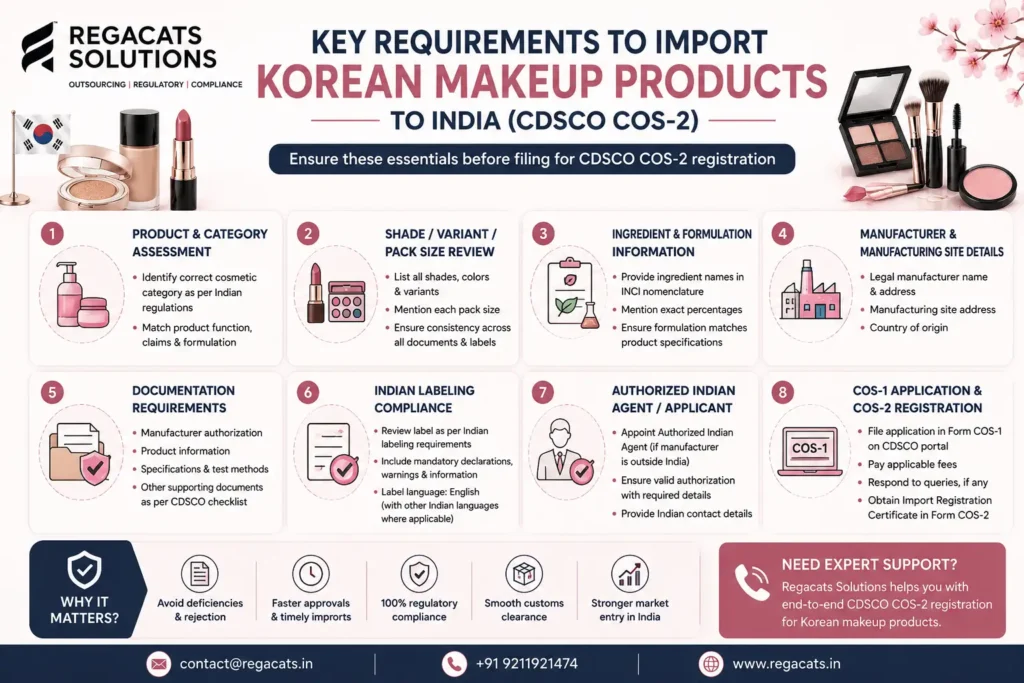
Therefore, before you import Korean makeup products, review:
- Product name
- Product category
- Variant or shade information
- Pack size
- Manufacturer
- Manufacturing premises
- Ingredient information
- Proposed labeling
- Product documentation
- Authorization documentation
This product-level review can prevent inconsistencies later in the registration process.
Korean Makeup Variants and Shades: What Should Importers Check?
Variants deserve special attention in makeup registration.
CDSCO’s FAQ explains that variants can include differences such as colors, shades, flavours, fragrances, or other inherent characteristics apart from the base formulation. It also explains that a kit or palette sold as a single retail unit can be treated as a single variant in the circumstances described by the guidance.
For makeup businesses, this distinction becomes particularly important.
For example, suppose a Korean manufacturer offers:
- Foundation — 10 shades
- Lip tint — 8 shades
- Blush — 6 shades
- Concealer — 12 shades
The importer should not simply describe the portfolio as “makeup products.” Instead, the registration preparation should accurately reflect the relevant products and variants.
Before filing, verify:
- The product name matches the manufacturer’s documentation.
- Shade names remain consistent across documents.
- Pack sizes match the intended registration details.
- Product variants appear consistently across the authorization and product documentation.
- Manufacturing information matches the manufacturer’s records.
- The proposed Indian label reflects the relevant product information.
CDSCO’s current online checklist specifically asks for product name, pack sizes, variants, and actual manufacturing information as part of the authorization documentation.
If you need a broader explanation on cosmetic import registration, see our guide on Cosmetic Import registration in India.
What Documents Are Required to Import Korean Makeup Products?
The exact documentation depends on the product and application circumstances. However, importers should expect to prepare a structured regulatory dossier rather than only commercial invoices and shipping documents.
CDSCO’s guidance and checklist identify several important information and documentation requirements. These include manufacturer authorization, product information, ingredient information, proposed labeling, specifications and testing methods, and other supporting information required under the Cosmetics Rules, 2020.
A practical preparation checklist can include:
- Manufacturer authorization
- Manufacturer and manufacturing-site details
- Product details
- Product category
- Variant information
- Pack sizes
- Ingredient information
- Proposed labels
- Specifications
- Testing methods
- Package inserts, where applicable
- Supporting certificates and documents
- Fee payment documentation
- Applicant/Indian Agent information
The manufacturer authorization deserves particular attention. CDSCO’s guidance states that the authorization should identify the manufacturer, manufacturing premises, Authorized Indian Agent, cosmetic product, variants, and manufacturing premises, with the required authentication and signatures.
For a detailed document-by-document reference, use the Cosmetic Import License Documents – CDSCO Checklist before preparing the final submission.
Does the Korean Manufacturer Need an Authorized Indian Agent?
The Cosmetics Rules allow an application for imported cosmetics to be made by the manufacturer, its Authorized Agent, an importer in India, or an authorised Indian subsidiary, subject to the applicable requirements. The manufacturer’s authorization to its Indian agent must also meet the authentication requirements specified under the rules.
For foreign manufacturers, the Authorized Indian Agent therefore plays an important compliance role.
The agent can help coordinate:
- Manufacturer documentation
- Product information
- Registration submission
- Regulatory correspondence
- Indian compliance requirements
- Documentation updates
- CDSCO queries
However, businesses should clearly define the responsibilities of the manufacturer, importer, distributor, and Authorized Indian Agent before filing.
Need Indian agent services, visit: Indian Agent Services for Cosmetic export to India.
Korean Makeup Labeling Requirements in India
Label compliance should not become an afterthought.
A product may have compliant packaging for the Korean market but still require review for Indian import and sale requirements. Therefore, businesses should compare the manufacturer’s existing packaging with the applicable Indian requirements before commercial production or shipment.
Review:
- Product identity
- Product category
- Manufacturer information
- Importer or responsible-party information where applicable
- Net contents
- Batch information
- Relevant dates
- Usage information
- Warnings and precautions where applicable
- Ingredient information
- Country-of-origin information where required
- Other declarations applicable under Indian requirements
CDSCO’s registration checklist specifically requires information about the proposed manner of labeling as part of the product documentation.
For the broader framework, refer to Labeling Requirements for Cosmetic Products in India.
Why label review matters for Korean makeup
Makeup packaging frequently contains:
- Korean-language text
- English claims
- Multiple shade names
- Marketing claims
- Symbols
- Small-pack information
- Product-specific instructions
Therefore, the importer should review the final commercial packaging rather than assuming that the manufacturer’s existing artwork automatically satisfies Indian requirements.
What Should Importers Check About Korean Makeup Ingredients?
Ingredient review is another important preparation step.
CDSCO’s checklist calls for the names of ingredients in the relevant standard nomenclature along with their percentages contained in the cosmetic.
Before filing, compare the ingredient information across:
- Product specification
- Manufacturer documentation
- Formula information
- Registration documents
- Label
- Supporting certificates
The information should remain consistent.
Furthermore, don’t rely only on the product’s marketing description.
A product may be marketed as:
- “Glow makeup”
- “Long-wear foundation”
- “Hydrating cushion”
- “Natural finish tint”
Those claims do not replace the need to understand the actual cosmetic formulation and regulatory information.
CDSCO also states that imported cosmetics must comply with the applicable quality and safety specifications under the Cosmetics Rules, 2020.
How to Prepare Korean Makeup Products for COS-2 Registration
The process begins with product assessment, not the online form.
Step 1: Build the Korean Makeup Product List
Create a master list containing:
- Product name
- Category
- Variant/shade
- Pack size
- Manufacturer
- Manufacturing site
- Brand information
This gives you a reliable registration baseline.
Step 2: Review Product Classification
Determine the appropriate cosmetic category under the applicable framework.
Don’t rely solely on the Korean product category.
Step 3: Collect Manufacturer Documents
Obtain the required manufacturer authorization and supporting documentation.
Step 4: Review Ingredients
Check ingredient names, percentages, specifications, and supporting documents.
Step 5: Review Labels
Compare the existing Korean packaging with Indian requirements.
Step 6: Reconcile Variants
Make sure shades, colors, pack sizes, and product names remain consistent throughout the dossier.
Step 7: Prepare Form COS-1
The applicant submits the import registration application through the applicable CDSCO online process. CDSCO’s guidance identifies Form COS-1 as the application for the Import Registration Certificate in Form COS-2.
Step 8: Submit Supporting Documents
Upload the applicable documentation and fee information.
Step 9: Respond to Regulatory Queries
If CDSCO raises a deficiency or clarification, review the query carefully and respond with consistent supporting information.
Step 10: Maintain Registration Records
Once registration is granted, maintain the approved product, manufacturing-site, variant, and documentation records carefully.
What Is the CDSCO COS-2 Registration Process for Korean Makeup?
At a high level, the process works like this:
Korean Manufacturer
↓
Product & Variant Assessment
↓
Ingredient & Documentation Review
↓
Label Review
↓
Authorized Indian Agent / Applicant Preparation
↓
Form COS-1 Submission
↓
CDSCO Review
↓
Query / Deficiency Response if Required
↓
COS-2 Import Registration Certificate
↓
Import & Market-Entry Compliance
CDSCO’s Cosmetics Rules state that the registration application is made through the online portal in Form COS-1, while the Central Licensing Authority may grant the Import Registration Certificate in Form COS-2 after examination of the application.
For a detailed general process, see How to Import Cosmetics into India: Step-by-Step CDSCO Process.
How Long Does Korean Makeup Registration Take?
The timeline depends on the completeness of the submission, the product portfolio, documentation, regulatory review, and any queries or deficiencies that arise.
The Cosmetics Rules state that, after examination of the documents, the Central Licensing Authority may grant the Import Registration Certificate in Form COS-2 or reject the application with reasons recorded in writing within a period of six months from the date of application.
That statutory framework should not be interpreted as a promise that every application will take the same amount of time.
In practice, importers should allow sufficient time for:
- Product assessment
- Manufacturer documentation
- Authorization
- Label review
- Application preparation
- Submission
- Regulatory scrutiny
- Query resolution
For a dedicated discussion of timing, see CDSCO Cosmetic Import Registration Timeline (COS-2 India).
How Much Does Korean Makeup Import Registration Cost?
The registration cost depends on the applicable fee structure and the number and nature of products, manufacturing sites, categories, and variants involved.
The Cosmetics Rules provide for fees by cosmetic category and manufacturing site, with additional fees for variants and other applicable registrations.
This matters particularly for makeup because a large portfolio can contain many shades and variants.
Therefore, don’t estimate the registration budget solely from the number of product names.
Instead, prepare a product matrix containing:
| Information | Example |
|---|---|
| Product | Foundation |
| Category | Face makeup |
| Manufacturer | Korean manufacturer |
| Manufacturing site | Specific facility |
| Variant | Shade |
Then use the applicable fee structure to estimate the regulatory budget.
For more detail, see Cosmetic Import License Fees in India (COS-1 & COS-2).
Common Problems When Importing Korean Makeup Products
A strong registration strategy should identify potential problems before submission.
1. Variant mismatches
The shade name in the manufacturer’s document may differ from the application or label.
Solution: Create one master variant list and use it consistently.
2. Manufacturer information differences
The manufacturer name or manufacturing address may appear differently across documents.
Solution: Reconcile the exact legal and manufacturing information before filing.
3. Incomplete authorization
The authorization document may not contain all required product, variant, agent, or manufacturing-site details.
Solution: Review the authorization against the current CDSCO requirements before submission.
4. Label inconsistencies
The proposed label may not align with the registration documentation.
Solution: Perform a regulatory label review before final submission.
5. Incomplete ingredient information
The product dossier may not provide the ingredient information in the required format.
Solution: Obtain complete formulation information from the manufacturer and reconcile it with the supporting documents.
6. Poor product categorization
A marketing team may describe a product differently from the applicable cosmetic category.
Solution: Assess the product based on its formulation, intended use, claims, and applicable regulatory framework.
7. Treating every shade as a completely unrelated product
This can create confusion during registration preparation.
Solution: Understand the applicable definition and treatment of variants. CDSCO specifically recognizes colors, shades, fragrances, flavours, and other inherent characteristics as potential variants.
If an application receives a deficiency, don’t simply upload another document without understanding the underlying issue. Use our guide on Cosmetic Import Registration Deficiencies (CDSCO COS-2 Guide) to understand how to approach regulatory queries systematically.
Korean Makeup Import Checklist
Before you proceed with a commercial import, use this checklist:
Identify every Korean makeup product.
Confirm the applicable cosmetic category.
Identify the manufacturer.
Identify each manufacturing premises.
Prepare product and variant information.
Record shade information accurately.
Record pack sizes.
Review ingredient information.
Collect manufacturer authorization.
Review proposed labels.
Check documentation consistency.
Confirm the applicant/Authorized Indian Agent structure.
Prepare the Form COS-1 application.
Check applicable fees.
Submit the application through the applicable CDSCO process.
Track regulatory queries.
Respond to deficiencies with consistent supporting evidence.
Maintain the final registration records.
This checklist provides a practical starting point, but the exact requirements can vary depending on the product and application circumstances.
Can You Import Korean Makeup Before COS-2 Registration?
For cosmetics that fall under the applicable import-registration requirements, businesses should not treat commercial import as something they can complete first and regularize later.
CDSCO states clearly that no cosmetic should be imported into India unless the product has been registered according to the Cosmetics Rules, 2020.
Therefore, businesses should complete the applicable registration preparation before arranging commercial imports.
If a company imports products without the required registration, it can create regulatory and commercial risks.
For a broader explanation, see Importing Cosmetics Without CDSCO License – India Risks.
Can a Korean Manufacturer Export Directly to India Without an Indian Compliance Structure?
A foreign manufacturer should establish the appropriate applicant and authorization structure before starting the registration process.
The Cosmetics Rules permit the application to be made by the manufacturer, its authorised agent, an importer in India, or an authorised subsidiary in India, subject to the applicable provisions.
However, businesses should clearly establish who will manage the Indian regulatory responsibilities.
For many foreign manufacturers, an experienced Indian regulatory partner can simplify:
- Document coordination
- Application preparation
- Regulatory communication
- Query management
- Label review
- Registration record management
This is especially useful when the Korean manufacturer does not maintain a dedicated regulatory team in India. Need support for cosmetic import registration, contact Regacats Solutions for Cosmetic Import Registration Consultant in India
How Regacats Solutions Can Help With Korean Makeup Import Registration
Importers often focus on sourcing and sales first. However, regulatory preparation can determine how smoothly a product reaches the Indian market.
Regacats Solutions supports businesses involved in cosmetic imports into India by helping coordinate regulatory preparation and compliance activities.
Our support can include:
- Product and variant assessment
- Documentation review
- Manufacturer authorization coordination
- Label compliance review
- Indian Authorized Agent support
- COS-1 application preparation
- CDSCO submission support
- Regulatory query and deficiency support
- Registration documentation management
- Import-readiness guidance
The objective is straightforward: help businesses identify compliance issues before they disrupt commercial plans.
For Korean businesses entering India, this can be particularly valuable when the product portfolio contains many shades, variants, pack sizes, or manufacturing locations.
Need Support from cosmetic registration consultant in India, contact Regacats Solutions
If you are planning to import Korean cosmetics products into India, Regacats Solutions can help you assess your product portfolio, review documentation, coordinate Authorized Indian Agent requirements, prepare COS-1 registration documentation, review labels, and manage regulatory communication.