
Understanding cosmetic labeling requirements in India is essential to avoid delays and ensure smooth approval. Importing cosmetic products into India requires compliance with Cosmetics Rules, 2020. Labeling is one of the most important regulatory requirements and plays a key role in product approval and market entry.
Many importers face delays due to incorrect or incomplete labeling. Understanding cosmetic labeling requirements in India helps avoid such issues and ensures smooth approval.
Are you a Cosmetic Importer, foreign manufacturer, Cosmetic exporter or global cosmetic brand wish to enter Indian Market?
Explore CDSCO Cosmetic Import Regulatory Services in India to get Cosmetic import license in 30–40 days with Regacats Solutions.
Need Help Reviewing Cosmetic Labels Before Importing Products into India?
Incorrect labeling remains one of the most common reasons for delays, clarification requests, and compliance issues during cosmetic import registration in India. Therefore, importers, distributors, foreign cosmetic brands, and manufacturers should review product labels carefully before proceeding with cosmetic import registration.
Regacats Solutions helps businesses with:
- Cosmetic label compliance review
- CDSCO cosmetic import registration
- COS-2 application preparation
- Indian Authorized Agent support for cosmetics
- Cosmetic documentation review
- End-to-end import compliance assistance
If you need assistance from a cosmetic import registration consultant in India, our team can help you review labeling requirements and prepare for cosmetic import registration in India.
📧 contact@regacats.in | 📞 +91 9211921474
Importance of Labeling Compliance for Cosmetics Import in India
Labeling is essential for regulatory approval and consumer safety.
- Provides accurate product information
- Ensures regulatory compliance
- Helps in product traceability
- Prevents misleading claims
Non-compliance may lead to:
- CDSCO queries
- Application delays
- Rejection of approval
- Customs clearance issues
Working with a cosmetic import license consultant helps ensure proper compliance.
Key Cosmetic Labelling Compliacne Requirements for Cosmetic Import in India
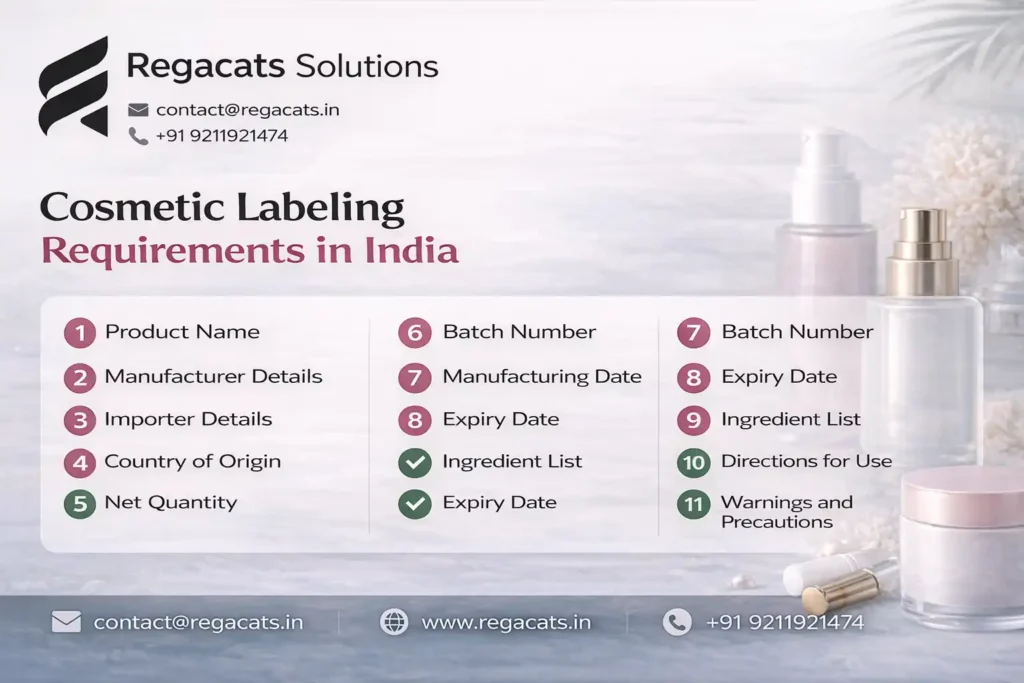
1. Name of the Cosmetic Product
The product name must be clearly mentioned on the label.
- Should match CDSCO application
- Must not be misleading
- Should reflect actual product type
2. Manufacturer Details
The label must include manufacturer information.
- Name of manufacturer
- Complete address
- Country details
3. Importer Details
Importer details are mandatory for imported cosmetics.
- Name of Indian importer
- Full address of importer
4. Country of Origin
The country of origin must be clearly mentioned.
- Example Made in Korea
- Example Made in USA
- Example Made in Japan
5. Net Quantity Declaration
The label must specify product quantity.
- Weight or volume must be mentioned
- Must comply with legal metrology rules
- Should be clearly visible
6. Batch Number
Each product must include a batch number.
- Helps in product traceability
- Required for quality control
- Useful for product recall
7. Manufacturing and Expiry Date
Date information must be included on the label.
- Manufacturing date
- Expiry date or best before
8. Ingredient List
Ingredients must be listed properly.
- Listed in descending order
- Use standard nomenclature
- Ensure accuracy of composition
Incorrect listing can lead to regulatory issues.
9. Directions for Use
Usage instructions must be clearly mentioned.
- Method of application
- Usage frequency
- Special instructions if any
10. Warnings and Precautions
Safety information must be included where applicable.
- For external use only
- Avoid contact with eyes
- Keep away from children
Labeling Requirements for Outer and Inner Packaging
Labeling requirements apply to both types of packaging.
- Primary packaging
- Secondary packaging
Outer packaging can include additional details if space is limited.
Common Labeling Mistakes in Cosmetic Import
Many importers make common errors.
- Missing importer details
- Incorrect ingredient listing
- Missing country of origin
- Incomplete declarations
- Non-compliant formatting
These issues often delay approval.
Businesses often rely on CDSCO consultant for cosmetic import to avoid such errors.
CDSCO Review of Labeling During Import Approval
CDSCO reviews labeling during the approval process.
- Checks regulatory compliance
- Verifies product claims
- Reviews ingredient safety
- Ensures completeness
Non-compliance may lead to queries or rejection.
Labeling Compliance and Customs Clearance
Labeling also affects customs clearance.
- Authorities may inspect labels
- Declarations are verified
- Country of origin is checked
Non-compliance may result in:
- Shipment delays
- Additional documentation requirements
- Clearance issues
Best Practices for Cosmetic Labeling Compliance
Follow these practices to ensure smooth approval.
- Include all mandatory details
- Verify ingredient compliance
- Ensure clarity and readability
- Review label before submission
- Align with CDSCO guidelines
Role of Regulatory Experts in Labeling Compliance
Professional support helps in ensuring compliance.
- Label review and correction
- Regulatory alignment
- Reduction in rejection risk
- Faster approval process
Many businesses prefer expert support for cosmetic import registration consultant.
Common Cosmetic Labeling Mistakes That Delay Import Approval in India
Businesses importing cosmetic products into India often focus on product sourcing, pricing, and distribution. However, cosmetic label compliance is equally important during import preparation. Even minor inconsistencies between product labels and supporting documents can create avoidable delays during the registration process.
Therefore, importers, foreign manufacturers, distributors, and cosmetic brands should review cosmetic labels carefully before proceeding with cosmetic import registration activities.
1. Product Name Inconsistencies
The product name appearing on the label should remain consistent across product packaging, supporting documentation, declarations, and registration records. Differences in product naming conventions can create confusion during document review and may result in additional clarification requirements.
2. Ingredient Declaration Mismatches
Ingredient declarations should accurately reflect the product formulation and remain consistent across all supporting records. Businesses should review ingredient information carefully before preparing cosmetic import registration documentation. Proper ingredient review helps improve compliance readiness and reduces the risk of avoidable registration concerns.
3. Incorrect Manufacturer Information
Manufacturer details appearing on labels should match the information provided in supporting documents. Inconsistencies in manufacturer names, addresses, or production site information may require additional review before registration activities can move forward.
4. Missing or Incomplete Importer Information
Importers should verify that applicable importer details and related information are presented correctly on cosmetic labels before product launch and market entry. Accurate importer information helps maintain consistency throughout the registration process.
5. Product Category Misclassification
The product category stated on labels should align with product documentation and intended use. Proper product categorization helps maintain consistency throughout the cosmetic import registration process.
6. Label and Document Inconsistencies
One of the most common challenges involves differences between product labels and submitted documentation. Businesses should review labels, declarations, product information, and supporting records together to ensure consistency before registration preparation.
Many cosmetic import applications experience avoidable delays because of documentation gaps, inconsistencies, or review observations. Importers can learn more by reviewing our detailed guide on common cosmetic import registration deficiencies under the CDSCO COS-2 process, which explains frequent compliance issues observed during cosmetic import registration preparation.
Why Early Label Review Matters
A structured label review process helps businesses identify potential issues before preparing cosmetic import registration applications. Early review can improve compliance readiness, support smoother documentation preparation, and reduce avoidable clarification stages later in the process.
Businesses should also understand how labeling requirements fit within the broader cosmetic import registration framework. For a complete overview of registration requirements, eligibility, documentation, timelines, and compliance considerations, readers can review our comprehensive cosmetic import license guide.