
If you are developing, manufacturing, importing, or commercializing a food product or food ingredient that does not clearly fall under an existing FSSAI standard, you may need to evaluate the FSSAI Non-Specified Food & Ingredient (NSF) framework before bringing the product to the Indian market.
FSSAI has established a specific regulatory framework for the approval of Non-Specified Food and Food Ingredients under the Food Safety and Standards (Approval for Non-Specified Food and Food Ingredients) Regulations, 2017. The framework covers food products as well as food ingredients for which standards have not been specified under the applicable regulations.
However, a product does not become Non-Specified Food simply because it is new, imported, innovative, or unfamiliar to a particular business. The first step is always to determine whether an applicable FSSAI standard, category, or regulatory pathway already exists.
This guide explains what is Non-Specified Food & Ingredient (NSF), including what NSF means, when approval may be required, how Non-Specified Food Ingredients are assessed, the approval process, documents, ePAAS, risk assessment, fees, timelines, common issues, and how businesses can prepare for regulatory review.
What Is Non-Specified Food Under FSSAI?
A Non-Specified Food refers to a food product, ingredient, or substance that is not specifically covered under existing FSSAI regulations and standards. In simple terms, if a product contains an ingredient or formulation that does not clearly fit within established regulatory categories, it may require additional regulatory evaluation before it can be marketed in India.
Many businesses assume that every ingredient automatically falls under existing regulations. However, that is not always the case. Certain ingredients, novel formulations, or unique combinations may require a separate review to determine their regulatory status and suitability for the Indian market.
Businesses should pay special attention when:
1. Using new or innovative ingredients
2. Introducing ingredients with limited history of use in India
3. Developing unique nutraceutical formulations
4. Importing products containing specialized ingredients
5. Launching products with unconventional ingredient combinations
Since ingredient classification directly impacts compliance requirements, businesses should assess the regulatory status of ingredients before investing in product development, labeling, or commercialization.
If an ingredient does not clearly fall within existing standards, additional evaluation may be necessary through Non-Specified Food & Ingredient Approval Services in India.
Key Takeaway:
Not every ingredient automatically falls under existing regulations. Therefore, businesses should review ingredient compliance early in the product development process to avoid delays, regulatory objections, and unexpected approval challenges.
Therefore, businesses should not assume that an ingredient or product can enter the Indian market simply because it is legally sold in another country.
Indian regulatory status must be assessed separately.
To understand how ingredient compliance fits into the broader licensing process, you can also read FSSAI License for Nutraceuticals in India: Complete Guide.
What Does NSF Mean in FSSAI Compliance?
In FSSAI-related discussions, NSF is commonly used as a short form for Non-Specified Food.
When the regulatory framework covers both products and ingredients, businesses may also encounter the terminology Non-Specified Food and Food Ingredients, or NSF & FI.
For businesses, understanding both terms is useful because regulatory requirements can apply to:
- Finished food products
- Food ingredients
- Additives
- Processing aids
- Enzymes
- Specialized ingredients
- Ingredients intended for use in other food products
- Ingredients for use in Health Supplement & Nutraceutical category product
Therefore, NSF compliance should not be viewed only from the perspective of a finished food product.
A business importing or manufacturing an ingredient may need to assess the ingredient’s regulatory status separately.
What Is a Non-Specified Food Ingredient Under FSSAI?
A Non-Specified Food Ingredient is an ingredient for which an applicable standard has not been specified under the relevant FSSAI regulations.
The 2017 framework specifically addresses Non-Specified Food and Food Ingredients. Consequently, businesses should evaluate ingredients independently when determining whether a prior-approval requirement may apply.
This can become particularly relevant when a business wants to:
- Import an ingredient into India
- Manufacture a product using a specialized ingredient
- Introduce an ingredient that lacks an applicable Indian standard
- Use an ingredient in a nutraceutical formulation
- Commercialize a specialized food ingredient
- Determine whether an ingredient requires prior regulatory approval
However, the fact that an ingredient is new to the Indian market does not automatically establish that it is a Non-Specified Food Ingredient.
The correct approach is to assess the ingredient against the applicable FSSAI regulations and standards.
What Should Be Assessed for a Non-Specified Ingredient?
A regulatory assessment may consider:
- Ingredient identity
- Source of the ingredient
- Manufacturing process
- Composition
- Specifications
- Purity
- Intended use
- Proposed use level
- Target food application
- Safety information
- Scientific evidence
- Existing regulatory status
This assessment helps determine whether the ingredient already fits an established regulatory pathway or whether the NSF framework requires further consideration.
Non-Specified Food vs Non-Specified Food Ingredient
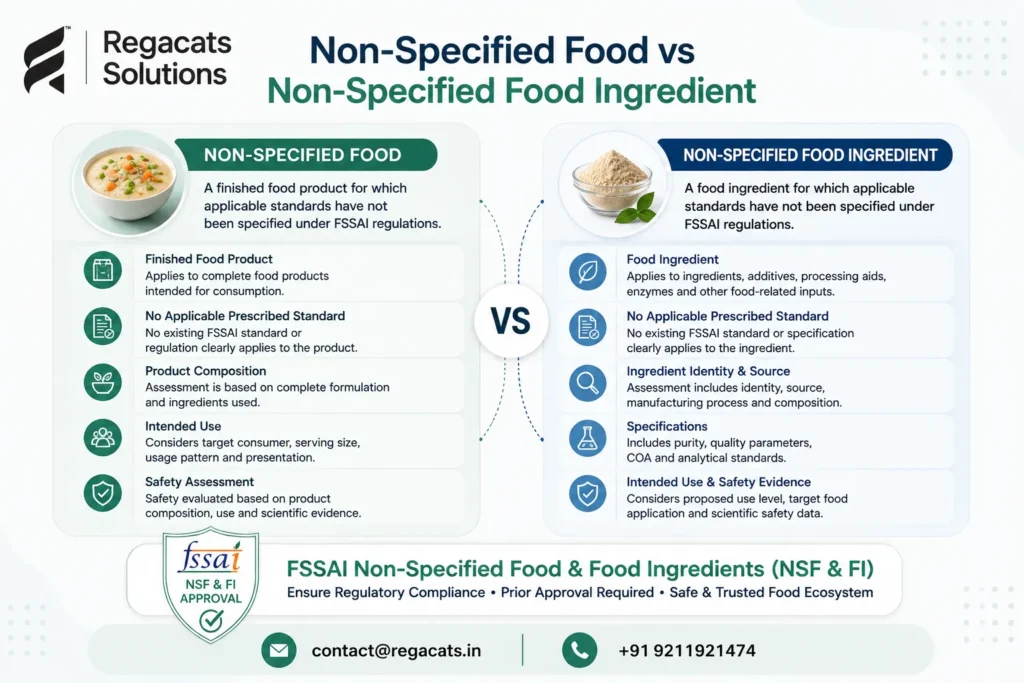
Although the same regulatory framework addresses both, businesses should understand the distinction.
Non-Specified Food
A food product for which an applicable standard has not been specified under the relevant FSSAI regulations.
Non-Specified Food Ingredient
A food ingredient for which an applicable standard has not been specified and which may require prior approval before its manufacture or import, depending on its regulatory status and intended use.
Why Does This Distinction Matter?
A finished food and an ingredient can require different technical assessments.
For a Non-Specified Food Ingredient, the assessment may focus heavily on:
- Identity
- Source
- Composition
- Manufacturing process
- Specifications
- Intended use
- Proposed use level
- Safety evidence
For a finished food product, the assessment may additionally consider:
- Complete formulation
- Product specifications
- Manufacturing process
- Serving size
- Target consumer
- Product presentation
- Proposed labeling
- Intended use
Therefore, businesses should prepare documentation based on the actual regulatory subject rather than using a generic application package.
When Is FSSAI NSF Approval Required?
The 2017 regulations require prior approval for the manufacture or import of Non-Specified Food or Food Ingredients covered by the regulations.
However, classification comes first.
The business should determine whether:
- An existing FSSAI standard applies
- The product falls within an established food category
- The ingredient has an applicable specification
- Proprietary Food provisions apply
- Another regulatory pathway applies
- The product or ingredient falls within the NSF framework
Potential situations that may require NSF assessment include:
- A food product does not have an applicable prescribed standard.
- An ingredient does not have an applicable prescribed standard.
- A food ingredient requires regulatory classification.
- An imported ingredient does not clearly fit an established Indian regulatory pathway.
- A specialized ingredient is intended for use in a regulated food product.
- A product’s regulatory status cannot be established from existing standards.
Therefore, businesses should avoid filing an NSF application simply because a product appears unusual.
A proper regulatory assessment can help identify the correct pathway before the business invests in manufacturing, importing, packaging, or commercialization.
Does Every New Food Ingredient Require NSF Approval?
No.
A new ingredient does not automatically require NSF approval.
For example, an ingredient may be new to:
- Your company
- Your product portfolio
- Your brand
- Your supplier relationship
- The Indian market
Yet the ingredient may already fall within an applicable FSSAI standard or regulatory provision.
Therefore, businesses should assess the following before deciding that NSF approval is necessary:
- What exactly is the ingredient?
- What is its source?
- How is it manufactured?
- What does it contain?
- What standard applies to it?
- How will it be used?
- At what level will it be used?
- What evidence supports its safety?
- Does the intended use fit an existing regulatory pathway?
- Does the ingredient require prior approval?
This approach reduces the risk of selecting the wrong regulatory route.
How to Determine Whether a Food or Ingredient Is Non-Specified
A structured regulatory assessment should precede the application.
Step 1: Identify the Product or Ingredient
Start with an accurate product or ingredient profile.
Record:
- Product or ingredient name
- Source
- Manufacturer
- Composition
- Manufacturing process
- Product format
- Intended use
- Proposed use level
Step 2: Check Existing FSSAI Standards
Determine whether an applicable FSSAI standard already covers the product or ingredient.
If an established standard applies, the business should evaluate that pathway before considering NSF approval.
Step 3: Review the Applicable Product Category
FSSAI’s product-category framework helps businesses identify whether a product falls within established categories.
For nutraceutical businesses, this step is especially important because the product may fall within the applicable nutraceutical framework rather than automatically requiring NSF approval.
Businesses can also review the broader FSSAI licensing requirements for nutraceutical products when assessing their overall regulatory pathway.
Step 4: Assess the Ingredient Separately
If the regulatory concern relates to an ingredient, assess the ingredient itself.
This is particularly important when the finished product may fall within an established category but the ingredient does not have an applicable standard.
Step 5: Determine the Appropriate Regulatory Pathway
After the assessment, the product may fall under:
- An existing specified standard
- Proprietary Food provisions
- A category-specific regulatory framework
- Non-Specified Food and Food Ingredients
- Another applicable regulatory pathway
Only after this assessment should the business proceed with the relevant compliance process.
FSSAI Non-Specified Food & Ingredient Approval Process
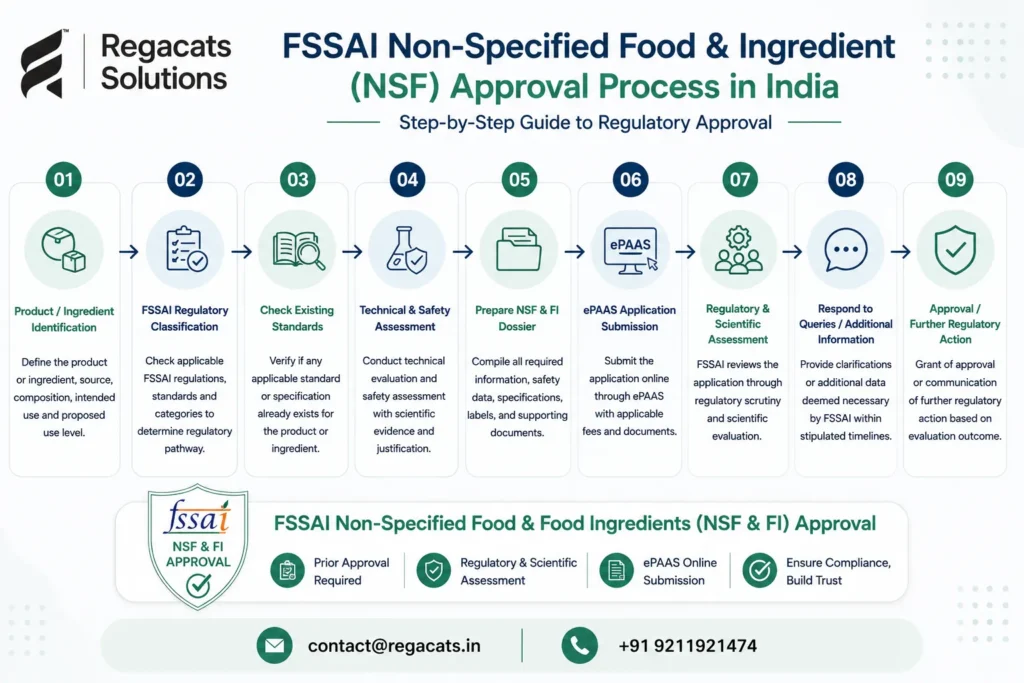
The NSF approval process involves several stages. Businesses should approach it as a regulatory assessment rather than simply an online application.
Step 1: Conduct Regulatory Classification
First, establish whether the product or ingredient falls within the NSF framework.
The assessment should explain:
- What the product or ingredient is
- What it contains
- Where it comes from
- How it is manufactured
- How it will be used
- Why an existing standard does not clearly apply
This creates the foundation for the application.
Step 2: Prepare Product or Ingredient Information
Prepare detailed technical information.
For an ingredient, this may include:
- Ingredient identity
- Source
- Composition
- Manufacturing process
- Specifications
- Purity
- Proposed use
- Proposed use level
For a finished food, the information may additionally cover:
- Complete formulation
- Manufacturing process
- Product specifications
- Serving size
- Target consumer
- Storage conditions
- Proposed label
Step 3: Assess Safety and Scientific Evidence
Safety assessment forms an important part of the regulatory process.
Depending on the product or ingredient, relevant evidence may include:
- Scientific publications
- Safety studies
- Toxicological information
- Human safety data
- Historical consumption information
- Exposure information
- Analytical data
- Manufacturing controls
The evidence should relate to the actual product or ingredient and its proposed use.
Simply attaching a large collection of scientific papers does not automatically create a strong safety dossier.
Step 4: Prepare the Technical Dossier
The technical dossier should present a clear and consistent regulatory story.
A useful structure is:
Identity → Composition → Manufacturing → Specifications → Intended Use → Safety → Proposed Application
This allows the reviewer to understand what the product or ingredient is, how it is produced, how it will be used, and what evidence supports the proposed use.
Step 5: Prepare the Application
After completing the regulatory and technical assessment, prepare the applicable application and supporting documents.
The 2017 regulations provide for the submission of an application along with the required information, documents, and applicable fee.
FSSAI may also require additional information, documents, data, or clarification during the assessment.
Therefore, businesses should prepare the dossier with enough technical depth to address foreseeable regulatory questions.
Step 6: Submit Through ePAAS
FSSAI has implemented the ePAAS (electronic Product & Claim Approval Application System) for applications under the Non-Specified Food and Food Ingredients framework.
Businesses should use the applicable current FSSAI system and verify the latest submission requirements before filing.
This makes it important to keep both the technical dossier and the digital application information consistent.
Step 7: Regulatory and Scientific Assessment
After submission, the application may undergo regulatory and scientific evaluation.
The assessment can consider:
- Product identity
- Ingredient identity
- Composition
- Manufacturing process
- Specifications
- Intended use
- Proposed use level
- Safety evidence
- Scientific information
The quality and relevance of the supporting evidence therefore matter significantly.
Step 8: Respond to Regulatory Queries
FSSAI may request additional information or clarification.
Queries can relate to:
- Ingredient identity
- Product formulation
- Safety evidence
- Manufacturing information
- Specifications
- Intended use
- Scientific literature
- Proposed use level
- Supporting documents
A query does not automatically mean rejection.
However, the response should directly address the issue and provide appropriate supporting information.
Documents Required for NSF & Food Ingredient Approval
There is no single document checklist that applies identically to every Non-Specified Food or Food Ingredient application.
Requirements depend on:
- Product type
- Ingredient type
- Source
- Formulation
- Intended use
- Manufacturing process
- Safety profile
- Regulatory status
However, businesses should evaluate the following documentation areas.
Product Information
For finished foods:
- Product name
- Product category
- Complete composition
- Manufacturing details
- Intended use
- Serving size
- Target consumer
- Proposed label
Ingredient Information
For Non-Specified Food Ingredients:
- Ingredient name
- Source
- Manufacturer
- Composition
- Manufacturing process
- Specifications
- Purity
- Proposed use
- Proposed use level
Technical and Quality Information
Depending on the application:
- Product specifications
- Ingredient specifications
- Certificate of Analysis
- Analytical reports
- Quality-control information
- Stability information where relevant
Safety Information
Depending on the product or ingredient:
- Scientific literature
- Safety studies
- Toxicological information
- Human safety information
- Historical use information
- Exposure assessment
- Other relevant scientific evidence
Regulatory Information
Where relevant:
- Existing regulatory status
- Previous approvals
- International regulatory information
- Product history
- Applicable Indian standards
- Proposed Indian use
Label and Claims Information
Where applicable:
- Proposed label
- Ingredient declaration
- Usage instructions
- Warnings
- Claims
- Supporting evidence
Businesses should ensure that the information remains consistent throughout the application.
For businesses preparing a nutraceutical product alongside NSF assessment, the detailed documents required for nutraceutical licensing can help with the broader licensing documentation exercise.
FSSAI NSF Approval for Non-Specified Ingredients
Non-Specified Food Ingredients deserve particular attention because the ingredient itself can become the subject of regulatory assessment.
A business may have an ingredient that is:
- Manufactured outside India
- Used internationally
- Supported by scientific literature
- Intended for use in a nutraceutical product
- Intended for use in another food product
- Commercially available in other jurisdictions
However, those facts alone do not establish Indian regulatory approval.
The business should first determine whether the ingredient has an applicable Indian standard or regulatory provision.
If no applicable standard clearly covers the ingredient, the business should assess whether it falls within the NSF & FI framework.
Ingredient Assessment Should Cover
Identity: What exactly is the ingredient?
Source: What is its source?
Manufacturing: How is it produced?
Composition: What does it contain?
Specifications: What quality parameters apply?
Intended use: Where will it be used?
Use level: At what quantity will it be used?
Safety: What evidence supports the proposed use?
Regulatory status: What FSSAI requirements apply?
This structured approach can help identify regulatory issues before the business commits to importation or commercialization.
FSSAI NSF Approval for Imported Ingredients
Imported ingredients require additional attention because an overseas regulatory status does not automatically establish compliance in India.
An international supplier may provide:
- Certificate of Analysis
- Product specifications
- Manufacturing information
- Safety studies
- International regulatory approvals
- Technical documentation
These documents can support the Indian regulatory assessment. However, the business still needs to determine the applicable Indian regulatory pathway.
Before importing a potentially Non-Specified Food Ingredient, businesses should evaluate:
- Indian regulatory classification
- Ingredient status
- Intended use
- Proposed use level
- Technical documentation
- Safety evidence
- Import requirements
- Label implications
For businesses importing nutraceutical ingredients, nutraceutical import compliance in India should be assessed alongside the ingredient’s regulatory status.
NSF Approval for Nutraceutical Ingredients
Nutraceutical businesses frequently work with specialized ingredients.
However, not every nutraceutical ingredient automatically requires NSF approval.
The business should first establish:
- Whether the ingredient has an applicable FSSAI standard
- Whether the ingredient falls within an applicable nutraceutical category
- Whether the intended use is covered
- Whether the ingredient requires separate regulatory assessment
- Whether prior approval applies
If the ingredient does not have an applicable standard, the business should assess whether the NSF & FI framework applies.
This ingredient-level assessment should form part of the broader regulatory strategy for the finished nutraceutical product.
Businesses can also review the FSSAI License for Nutraceuticals in India: Complete Guide for the broader licensing framework.
Is NSF Approval the Same as an FSSAI License?
No.
This is one of the most important distinctions businesses should understand.
NSF Approval
NSF approval concerns the regulatory approval of a Non-Specified Food or Food Ingredient under the applicable framework.
FSSAI License
An FSSAI license relates to the food business activity conducted by the Food Business Operator.
Therefore, businesses should not assume that obtaining an FSSAI license automatically approves every ingredient used by the business.
Likewise, obtaining approval for a Non-Specified Food or Food Ingredient does not remove other applicable licensing or compliance requirements.
Depending on the business model, both product-level approval and food business licensing may need consideration.
Businesses requiring broader licensing support can explore FSSAI License & Registration Services for the Supplement & Nutraceutical.
NSF Approval and Proprietary Food
A product does not automatically become Non-Specified Food simply because its formulation is unusual.
FSSAI’s regulatory framework distinguishes Non-Specified Food from Proprietary Food in applicable situations.
For example, a product made from combinations of standardized ingredients may potentially fall under the Proprietary Food framework rather than automatically requiring NSF approval.
Therefore, businesses should evaluate:
- Product composition
- Ingredient status
- Existing standards
- Product category
- Proprietary Food provisions
- NSF provisions
This is another reason to complete classification before filing.
A wrong classification can result in unnecessary work, additional regulatory questions, or delays.
How Much Does FSSAI NSF Approval Cost?
The total cost of NSF approval should not be confused with the official government application fee.
A complete project can involve several cost components.
Government Application Fee
This is the applicable fee payable to FSSAI is INR 50,000 + 18% GST per application.
Professional and Technical Costs
Depending on the product or ingredient, additional costs may arise from:
- Regulatory assessment
- Technical dossier preparation
- Scientific literature review
- Safety assessment
- Laboratory testing
- Analytical studies
- Documentation preparation
- Regulatory consulting
- Query-response support
The exact project cost therefore depends on the complexity of the product or ingredient.
How Long Does NSF Approval Take?
The FSSAI official timeline is 4-6 months. Businesses often want a guaranteed approval timeline. However, a responsible regulatory assessment should avoid promising a fixed approval period.
The actual timeline can depend on:
- Product complexity
- Ingredient complexity
- Quality of documentation
- Scientific evidence
- Regulatory queries
- Additional information requirements
- Scientific assessment
- Applicant response time
Therefore, businesses should treat published or indicative timelines as guidance rather than a guaranteed commercial launch date.
A well-prepared application can nevertheless reduce avoidable delays caused by incomplete information, inconsistent documentation, or repeated clarification requests.
Common Reasons NSF Applications Face Queries or Delays
Even when a product potentially qualifies for NSF approval, the application may encounter regulatory questions.
1. Incorrect Regulatory Classification
The applicant may not clearly demonstrate why the NSF pathway applies.
2. Incomplete Ingredient Information
Important details about source, composition, manufacturing, or specifications may be missing.
3. Insufficient Safety Evidence
The available scientific information may not adequately support the proposed use.
4. Inconsistent Documentation
The formulation, specifications, technical dossier, application, and label may contain conflicting information.
5. Unclear Intended Use
The application may not clearly explain how the food or ingredient will be used.
6. Unclear Proposed Use Level
The proposed use level may require additional explanation or supporting evidence.
7. Poorly Organized Scientific Evidence
Submitting numerous scientific papers without explaining their relevance does not necessarily strengthen the application.
The evidence should relate to the actual ingredient, exposure, intended use, and proposed application.
8. Import Documentation Gaps
Imported ingredients may require additional information regarding identity, source, manufacturing, quality, and regulatory status.
9. Label or Claim Concerns
Proposed labeling or claims may create questions when they do not align with the technical dossier or applicable requirements.
10. Confusing Product Approval With Licensing
A business may complete its licensing requirements while overlooking a separate product or ingredient approval requirement.
How to Prepare a Strong NSF Application
A strong NSF application begins before the online submission.
Start With Regulatory Classification
First determine whether the product or ingredient genuinely requires the NSF pathway.
Build a Detailed Product or Ingredient Profile
Document:
- Identity
- Source
- Composition
- Manufacturing process
- Specifications
- Intended use
- Proposed use level
Build the Scientific Evidence Package
Collect relevant:
- Safety studies
- Scientific literature
- Toxicological information
- Human data where relevant
- Historical use information
- Analytical data
Check Document Consistency
Ensure that:
- Ingredient names match
- Product names match
- Formulation information matches
- Specifications match
- Proposed use matches
- Label information matches
Review Import Considerations
If the product or ingredient comes from outside India, assess import-related requirements before shipment planning.
Review Claims and Labeling
Ensure that proposed claims and labeling information remain consistent with the technical and regulatory position of the product.
Prepare for Potential Queries
Before submission, ask:
- Why does this product or ingredient require NSF assessment?
- What standard was considered?
- Why does the existing framework not clearly cover it?
- What evidence supports safety?
- Is the intended use clearly defined?
- Is the proposed use level adequately supported?
- Are the technical documents complete?
- Are all documents consistent?
This pre-submission review can significantly improve the quality of the application.
Why Early NSF Compliance Planning Matters
Regulatory classification should happen before major commercial commitments.
Consider the difference between these two approaches.
Reactive Approach
Product development
↓
Supplier agreement
↓
Packaging
↓
Inventory investment
↓
Regulatory issue discovered
This approach can create avoidable financial and operational risks.
Proactive Approach
Product concept
↓
Regulatory assessment
↓
Ingredient assessment
↓
Technical documentation
↓
Safety assessment
↓
Approval pathway
↓
Licensing and compliance
↓
Commercialization
The second approach gives businesses greater visibility before committing substantial resources.
Furthermore, early assessment can identify potential issues with ingredients, documentation, claims, labeling, importation, and regulatory classification before they become costly problems.
How Regacats Solutions Supports NSF & Food Ingredient Approval
At Regacats Solutions, we support manufacturers, importers, ingredient suppliers, nutraceutical businesses, brand owners, startups, and international companies navigating FSSAI regulatory requirements for Non-Specified Food and Food Ingredients.
Our support can include:
- Regulatory classification assessment
- Non-Specified Food assessment
- Non-Specified Food Ingredient assessment
- Ingredient regulatory review
- Technical documentation review
- Scientific evidence assessment
- Safety dossier coordination
- Application preparation support
- ePAAS submission guidance
- Regulatory query-response support
- Imported ingredient compliance assessment
- Nutraceutical regulatory support
Our approach begins with the product or ingredient rather than a generic application checklist.
That distinction matters because every product can present different regulatory questions.
If your product or ingredient may fall under the NSF framework, you can explore our Non-Specified Food & Ingredient Approval Services in India for dedicated regulatory assistance.
If the project also involves a nutraceutical product, you can coordinate the NSF assessment with broader FSSAI license consultant for the nutraceutical.
For imported nutraceutical ingredients, businesses can also review FSSAI Nutraceutical Import Consultant in India services.
NSF & Food Ingredient Approval Checklist
Before starting the approval process, businesses should review the following:
- Identify the exact food product or ingredient.
- Identify the manufacturer and source.
- Document the complete composition.
- Define the intended use.
- Define the proposed use level.
- Check applicable FSSAI standards.
- Determine whether an existing category applies.
- Assess whether Proprietary Food provisions apply where relevant.
- Assess whether the product or ingredient falls within the NSF framework.
- Evaluate the ingredient separately where necessary.
- Collect product and ingredient specifications.
- Collect Certificates of Analysis where applicable.
- Gather relevant safety information.
- Compile scientific evidence.
- Review manufacturing information.
- Review proposed labeling.
- Review product claims where applicable.
- Evaluate import requirements where applicable.
- Check document consistency.
- Determine the applicable application pathway.
- Verify the current government fee.
- Verify the current ePAAS requirements.
- Prepare for potential regulatory queries.