
Executive Summary: The Indian cosmetics market is rapidly embracing Japanese beauty products. This detailed guide explains how to import Japanese decorative cosmetics (makeup) into India under the CDSCO Cosmetics Rules, 2020. We cover the regulatory framework (Form COS-1/COS-2), the SUGAM portal application process, required documentation, product categories (foundations, lipsticks, eyeshadows, etc.), labeling and ingredient compliance, fees, timelines, and how to avoid common CDSCO queries. We also explain the role of the Indian Authorized Agent, post-approval obligations, and provide a practical checklist. High-quality images and infographics (below) illustrate key concepts. For related topics, see our guides on Japanese skincare and sunscreen imports.
Regulatory Overview: CDSCO COS-2 for Imported Makeup
Imported makeup is regulated as cosmetics under India’s Drugs & Cosmetics Act and the new Cosmetics Rules, 2020. All color cosmetics (foundations, BB/CC creams, concealers), lipsticks and lip color products, eye products (eyeshadow, eyeliner, mascara, brow makeup), face powders (compact and loose), blushes, makeup primers and removers, nail enamels, etc., require individual registration. Indian importers (or their foreign principals) must submit an online application (Form COS-1) on the CDSCO SUGAM portal. Once approved, CDSCO issues an Import Registration Certificate (Form COS-2) for each product. This COS-2 certificate is legally required before any commercial import of that cosmetic into India.
Key points:
- Authorized Application: Only an Indian entity (importer or authorized agent) can apply on SUGAM.
- Classification: Cosmetics are classified per the Fourth Schedule of the Rules; makeup categories (e.g. foundation, lipstick, powder) must use the correct schedule entry.
- Variants: Different colors/shades or scents are treated as separate variants. Each variant incurs additional fees. For example, each lipstick shade is a distinct variant.
- Valid Certificate: After issuance, the COS-2 registration is valid indefinitely (perpetuity) provided the 5-year retention fee is paid on time. Essentially, the certificate renews every 5 years via a retention fee (failure to pay leads to cancellation).
Japanese Makeup Product Categories
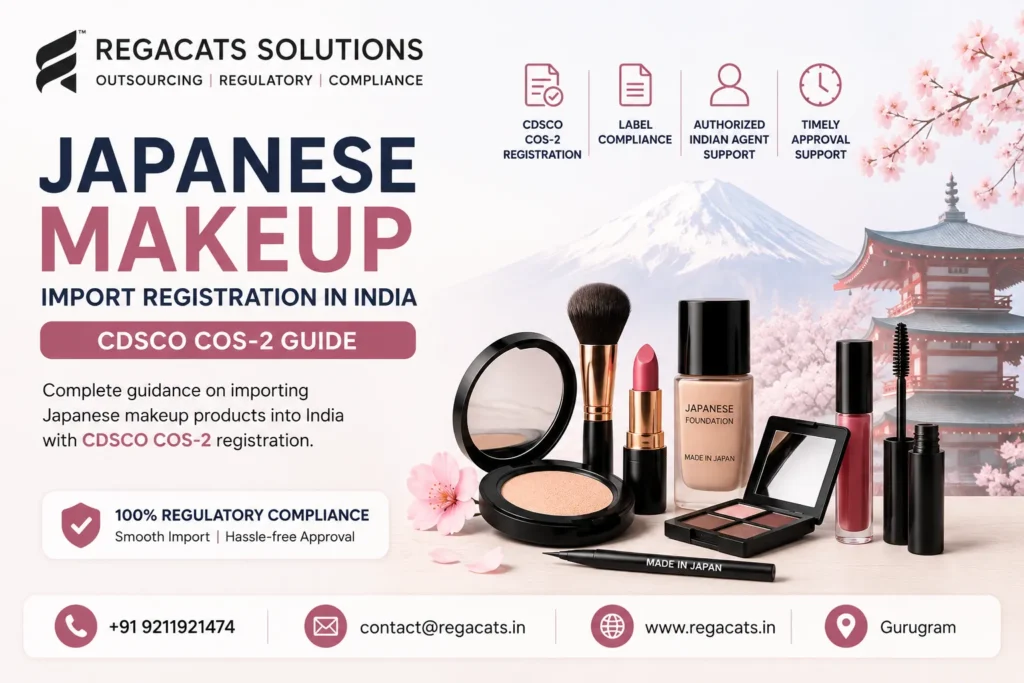
Makeup (decorative cosmetic) categories include: foundations and tinted creams, BB/CC creams, cushion compacts, concealers, face creams with cosmetic pigment, loose or pressed powders (e.g. setting powder, blush, bronzer), primers and base makeup, sunscreen-makeup hybrids, lipsticks/lip glosses/lip tints, liquid or powder blush, eyeshadows, eyeliners, mascaras, brow pencils, nail polish/enamel, makeup removers, and other color cosmetics. Each belongs to a cosmetic category in the Fourth Schedule.
For example, a company importing a Japanese lipstick brand with 10 shades must register each shade separately. The CDSCO defines a variant as each different colour, shade or flavour of a product. Therefore, if a foundation is offered in five colors, there are five variants to list in the COS-1 application.
For other Japanese beauty categories, see our guides on Japanese skincare products and Japanese sunscreen products.
CDSCO COS-2 Registration Process (SUGAM Portal) for Japanese Makeup Import
The import registration process involves these steps:
- Appoint an Indian Authorized Agent: The importer (or foreign brand) should designate a Indian agent to file the application and act on its behalf. Only an Indian entity can submit Form COS-1.
- Prepare Documentation: Gather all required documents (detailed below under “Documentation Checklist”). Ensure ingredients, labels, and paperwork are consistent.
- Register on CDSCO SUGAM Portal. Create an account or log in to SUGAM and start a COS-1 application for import registration. Fill in manufacturer and product details (note that these must match the authorization documents).
- Submit Application and Fee: Upload all documentation, product labels (draft for approval), and pay government fees (Bharatkosh e-payment). Once submitted, CDSCO will review the COS-1 application.
- Respond to Queries. If the CDSCO evaluator has questions (common in 20–30% of cases), respond promptly with clarifications or corrected documents. Typical queries involve label issues or mismatched ingredients (see section below).
- COS-2 Certificate Issuance. If all requirements are met, the Central Licensing Authority grants the Form COS-2 registration certificate. This occurs within the official processing timeline (90 days).
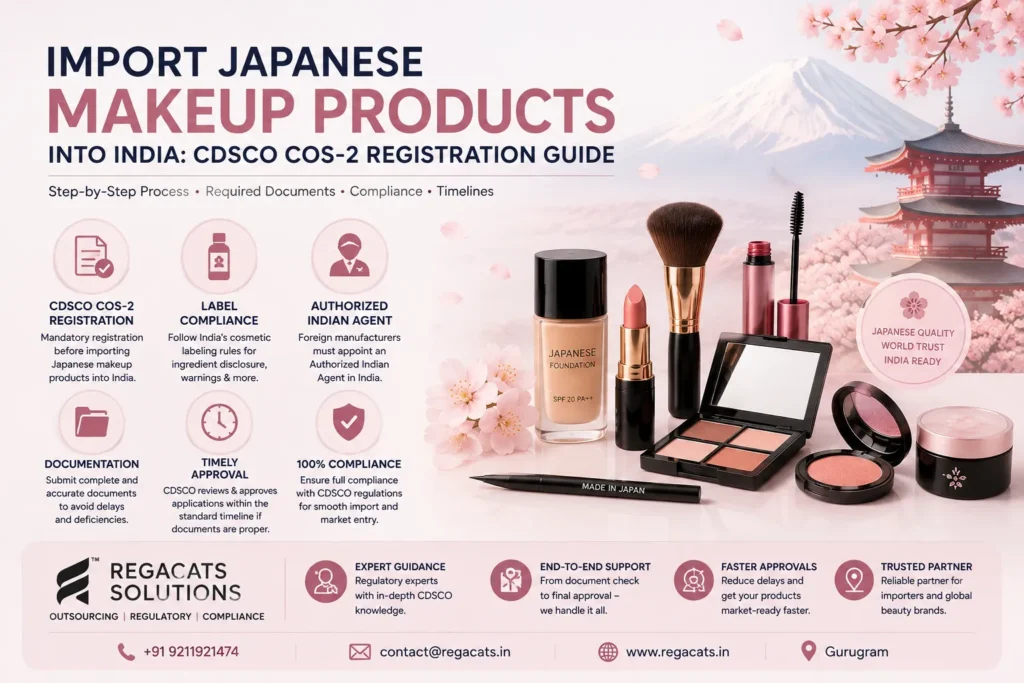
Timeline: The Cosmetics Rules allow up to 180 days for CDSCO to process a COS-1 import application. In practice, the goal is about 90 days with complete documentation. Delays often arise from incomplete docs or labeling errors. Planning ahead can shorten this timeline. Experienced cosmetic import registration consultants like Regacats Solutions often achieve approvals in 30–40 days.
Required Documentation Checklist for Japanese Makeup Import
Before applying, prepare a comprehensive set of documents. The key COS-2 application requirements (per CDSCO’s official checklist) include:
- Covering Letter: Explain the purpose (new application vs endorsement). Include index and references. If it’s a product/site endorsement (adding to existing COS-2), attach the old certificate copy.
- Manufacturer’s Authorization (Power of Attorney + Undertaking): The foreign manufacturer must issue a notarized and apostilled Power of Attorney naming the Indian agent. It should specify: manufacturer name/address, agent name/address, product name(s), pack sizes/variants, and the valid period of authorization. This document is critical.
- Cosmetic Product Details:
- Ingredient List: INCI names of all ingredients with percentages. Must match formulation data and label exactly.
- Proposed Label Artwork: Draft of the product label showing all required claims (see labeling section below).
- Specifications & Testing Methods: Technical specification sheet and test methods for key parameters (e.g. purity, content, pH, microbial limits).
- Package Inserts: If any instructional inserts accompany the product.
- Regulatory Certificates:
- Manufacturing License or Marketing Authorization: If the manufacturer (foreign) has a site or brand registration in the country of origin. For Japan products, a manufacturing license or Certificate of Pharmaceutical Product (CPP) from the origin country is needed. It must clearly list the product(s) by name.
- Free Sale Certificate (FSC): Issued by the competent authority in Japan (often METI or ministry websites). The FSC should match the product and manufacturer details and be valid at time of submission.
- Undertakings:
- Animal Testing Statement: A declaration (English) that the products were not tested on animals (per Indian rules).
- Chemical Declarations: Undertakings on heavy metal limits (BIS limits) and absence/presence of substances like hexachlorophene, as per CDSCO regulations.
- Company Documents: IEC, GST registration of the Indian applicant; manufacturer’s incorporation certificate if applicable.
- Fees: Copy of Bharatkosh e-payment receipt for the required fees (see below).
Organize these into a clear binder/folder (with page tabs) or digital PDF with index. The more complete and organized, the fewer CDSCO queries.
Product Variants and Fees
The fee structure is defined by the Third Schedule of the Cosmetics Rules:
| Fee Type | Amount (USD) |
|---|---|
| Import Registration (COS-2) per category | 1,000 |
| Additional category (if adding new type) | 1,000 |
| Manufacturing site fee (per site) | 500 |
| Each product variant (shade, etc.) | 50 |
For example, if a brand has one manufacturing site and imports cosmetics in two categories (e.g. foundation and blush), the base fee is $1,000. If each category has 5 color variants, that adds 5×$50 = $250 per category. Thus, fees can accumulate with many variants or sites. Plan your application to minimize cost (e.g. grouping similar products under one category if appropriate, or adding categories later as needed).
Additionally, mandatory retention fees equal to the registration fee (per category) are due every 5 years. Non-payment of retention (plus a late fee) leads to certificate cancellation.
Labeling & Ingredient Compliance for Japanese Makeup Import
Indian labeling rules are stringent. Imported makeup must fully comply with Cosmetics Rules, 2020 labeling requirements. Key points include:
- Mandatory Label Details: Product name, foreign manufacturer’s name/address, Indian importer/agent’s name and address, country of origin, batch/lot number, manufacturing date, expiry date or “best before” date, full ingredient list (descending order by weight using INCI names).
- Language: Labels must be in English or Hindi. Most foreign brands use English.
- Unit Measurements: Must use metric (grams, milliliters).
- Label Claims: Any claims on packaging should be substantiated (e.g. “whitening” or “anti-aging” claims may be scrutinized). Avoid disallowed claims.
CDSCO will cross-check the submitted label artwork against the registration documents. Common label issues that trigger queries include missing importer details, no mention of COS-2 number, or inconsistent ingredient order. Review labels carefully. (See our Cosmetic Labeling Requirements in India for full details.)
SUGAM Application Steps and Timeline
On the CDSCO SUGAM portal, the steps are:
- Form Selection: Choose “Registration Certificate” and Form COS-1 (which yields a COS-2 certificate if approved).
- Product Entry: Enter product name, category (as per Fourth Schedule), pack size, variants, manufacturer details (including site address and regulatory status), and compliance statements.
- Upload Documents: Attach PDFs of all documents listed above (POA, labels, spec sheet, FSC, undertakings, etc.).
- Payment: Pay the requisite fee via Bharatkosh.
- Submission & Tracking: Submit application. CDSCO will assign a tracking number. All correspondence (queries/clarifications) will occur via SUGAM.
Processing Time: CDSCO’s official timeline allows up to 6 months (180 days), but the target is ~90 days with a smooth application. Any deficiencies will reset the clock. In practice, companies should plan for ~3–6 months for full approval.
“…the Central Licensing Authority may, on being satisfied, grant [the registration] within six months from the date of application. However, CDSCO’s targeted timeline is 90 days…”
To get approval on time, prior consultation with cosmetic import license consultant is beneficial and may help importers to get approval in 30-40 days
Common CDSCO Queries & How to Avoid Them
During COS-1 review, CDSCO often raises queries. Common issues (and tips to avoid them) include:
- Ingredient List Discrepancies: Ensure the ingredient names and concentrations on the label, specification sheet, and Free Sale Certificate are identical. Mismatches (e.g. “Talcum” vs “Talc”) or missing ingredients trigger immediate queries. Tip: Cross-check all documents and use INCI names consistently.
- Improper PoA: The Power of Attorney must be properly signed, dated, and apostilled (or embassy-attested) and valid. Missing apostille, mismatched company names, or expired authorizations cause rejection. Tip: Obtain the PoA well in advance and verify all details.
- Label Non-Compliance: Missing importer address, no COS-2 number (if applicable), or incorrect ingredient order may lead CDSCO to ask for label revisions. Tip: Match the label exactly to the submitted application and follow Indian label rules (ingredients in descending order, include all mandatory info).
- Incomplete Manufacturer Data: Provide complete details of the manufacturing site (address, site license number, GMP certificate, etc.). Inconsistencies between the site on the POA and on the license causes queries. Tip: Double-check that every document lists the same manufacturing site details.
- Product Categorization Errors: If a product is miscategorized (e.g. lipstick entered under the wrong Fourth Schedule category), CDSCO will re-evaluate. Tip: Verify category entries against the Fourth Schedule before submission.
- Missing/Invalid Free Sale Certificate: The FSC must list the product by exact name and be from the proper authority in Japan. An expired or generic FSC triggers a request for a correct one. Tip: Obtain an FSC with the specific product name and ensure it’s valid on application date.
By conducting a thorough pre-submission audit, you can avoid many of these pitfalls. For a full list of typical deficiencies and fixes, see our Cosmetic Import Registration Deficiencies (COS-2) guide.
Indian Authorized Agent (Role & Requirements)
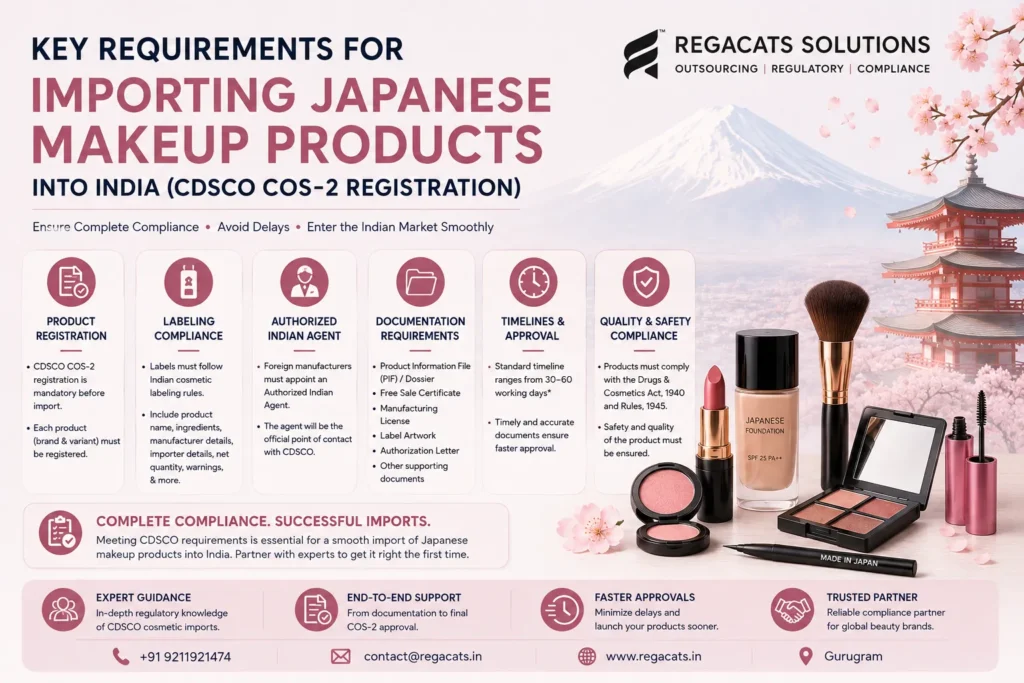
All foreign cosmetic manufacturers must work through an Indian Authorized Agent for CDSCO purposes. This is mandatory because only Indian entities can apply for a COS-2 import license. The agent’s duties include: filing the Form COS-1, communicating with CDSCO, receiving the COS-2 certificate, handling queries, and ensuring label and post-market compliance. The agent must have a valid IEC, GST, and a local office. Common valid agents are Indian subsidiaries of the brand, distributors, or specialized consulting firms.
For details, see our guide on appointing an Indian agent for cosmetics. In short: have the manufacturer issue a proper PoA to the chosen agent (as discussed above), and maintain active communication. A good agent significantly reduces delays and regulatory risk.
Post-Approval Obligations
Once the COS-2 certificate is granted, the importer must comply with ongoing obligations:
- Retention Fee: Pay the 5-year retention fee on time to keep the certificate active.
- Endorsements: If you add new products under an existing category or add a new manufacturing site, apply for an endorsement on the COS-2. This requires a COS-1 amendment with applicable fees (e.g. $50 per new variant, $1,000 per new category). The endorsement’s validity aligns with the original certificate.
- Recordkeeping: Maintain copies of all registration documents, labels, test data, and shipment records. CDSCO may inspect or audit these at any time.
- Marketing Compliance: Don’t sell beyond the declared expiry date, and keep an adverse-event reporting system in place (per Drugs and Cosmetics Act).
- Label Updates: If any label information changes (e.g. new address or claim), consult with CDSCO – sometimes a simple sticker (“relabeling”) is allowed, otherwise a new COS-2 may be needed.
Practical Checklist & Next Steps
To streamline your import registration:
- Plan Early: Start the process at least 3–6 months before product launch.
- Language Review: Ensure all documents (PoA, ingredient list, labels) are in English.
- Batch Sizes: If samples or pilot batches are needed, confirm with CDSCO if a separate application is required for clinical/batch trials.
- Professional Support: Consider hiring a CDSCO consultant (like Regacats Solutions) to prepare the application, as this avoids common oversights.
- Checklists: Use tables or workflows to tick off each requirement.
For expert help with your Japanese makeup import, get in touch with Regacats Solutions. We handle everything from COS-1/COS-2 filing to labeling review and SUGAM portal liaison, ensuring smoother and faster approvals. Contact us at contact@regacats.in or +91 92119 21474 for personalised support.