
Common Reasons CDSCO Rejects Cosmetic Import Applications in India
Cosmetic Import Rejection India is a growing concern for importers seeking CDSCO approval under the Cosmetics Rules, 2020. Many applications face delays or rejection because applicants underestimate documentation accuracy, ingredient compliance, and regulatory interpretation.
If you plan to obtain a COS-2 Registration Certificate, you must understand why CDSCO rejects cosmetic import applications in India. More importantly, you must know how to prevent those mistakes before filing Form COS-1 through the CDSCO SUGAM portal.
In this guide, we explain the most common rejection triggers, clarify the difference between deficiency and rejection, and outline structured prevention strategies to secure faster approval.
Why Does CDSCO Reject Cosmetic Import Applications?
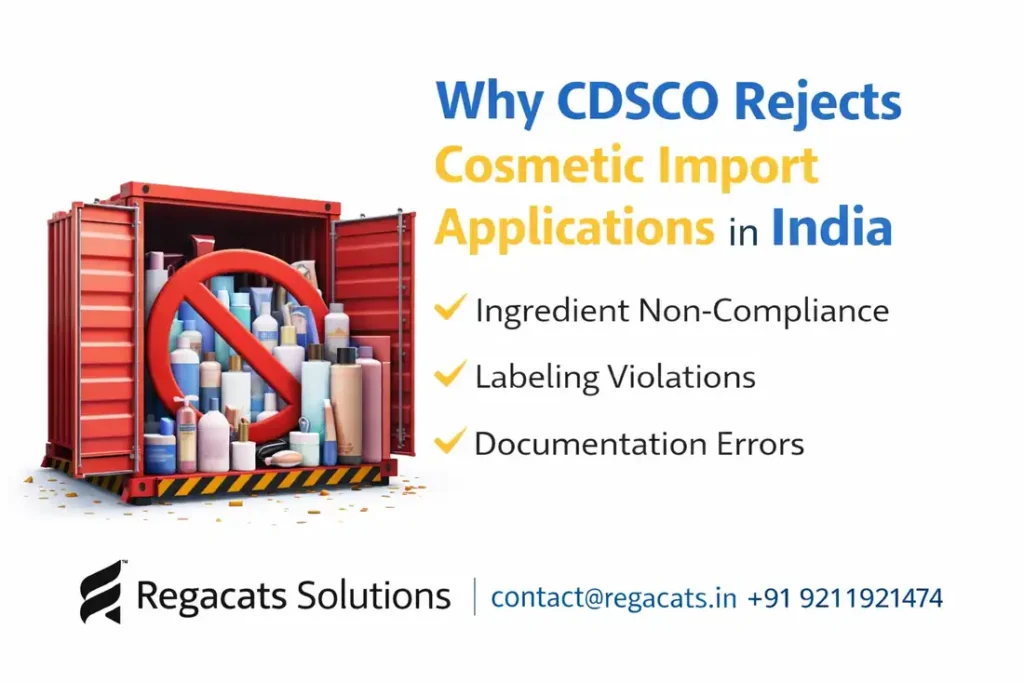
CDSCO typically rejects cosmetic import applications in India due to:
Ingredient non-compliance or restricted substances
Documentation mismatch across submitted forms
Invalid or incomplete Free Sale Certificate
Apostille errors in Power of Attorney
Labeling violations under Indian rules
Incorrect cosmetic classification
Manufacturer authenticity concerns
Missing declarations or undertakings
Below, we explain each rejection reason in detail.
Major Reasons Behind Cosmetic Import Rejection India Cases
Under the Cosmetics Rules, 2020, every cosmetic product manufactured outside India must obtain a valid COS-2 Registration Certificate before import and sale. CDSCO reviews Form COS-1 submissions carefully to ensure consumer safety and regulatory compliance.
Because cosmetic import registration operates within a legal framework, CDSCO cannot overlook inconsistencies. Therefore, even minor documentation gaps can result in rejection or extended queries.
If you need clarity on the filing process itself, review how to apply for cosmetic import license on CDSCO SUGAM portal before submitting your application.
Most Cosmetic Import Rejection India cases arise from preventable compliance gaps rather than complex legal barriers.
1. Ingredient Non-Compliance
Ingredient compliance forms the backbone of approval.
CDSCO evaluates:
Restricted substances
Concentration limits
INCI naming accuracy
Undisclosed components
If your formulation exceeds permissible limits or includes banned substances, CDSCO will not approve the application.
Moreover, mismatch between ingredient list and product specification increases rejection probability. Therefore, always validate ingredient composition before submission.
2. Documentation Inconsistency
Many cosmetic import rejection cases arise from documentation mismatch.
Common examples include:
Manufacturer name differs across FSC and GMP certificate
Address variation between documents
Product name mismatch between label and ingredient sheet
Signatory inconsistency in Power of Attorney
Although these errors appear administrative, they raise authenticity concerns.
Consequently, CDSCO may issue deficiency letters or reject the application entirely.
3. Invalid Free Sale Certificate
The Free Sale Certificate confirms that the product is legally sold in the country of origin. However, rejection occurs when:
FSC does not mention exact product names
FSC validity has expired
FSC lacks official seal
FSC refers only to manufacturer, not product
Because FSC validates commercial legitimacy, incomplete documentation directly impacts approval.
Before submission, ensure the certificate aligns perfectly with your product details.
4. Apostille or Power of Attorney Errors
Foreign manufacturers must appoint an Authorized Indian Agent through a properly apostilled Power of Attorney.
Rejection often occurs due to:
Missing apostille stamp
Improper signatory authority
Expired authorization
Mismatch between PoA and application details
Since the Authorized Indian Agent represents the foreign manufacturer legally, documentation accuracy remains critical.
5. Labeling Non-Compliance
Label artwork remains one of the most frequent rejection triggers.
Indian labeling rules require:
Importer name and full address
Manufacturing date and expiry date
Ingredient list in descending order
Batch number
Cosmetic claims without therapeutic implication
If artwork violates these standards, CDSCO will raise queries.
To understand common documentation and artwork gaps, review common CDSCO deficiencies in COS-2 applications for deeper insight.
6. Incorrect Product Classification
Sometimes, products marketed as cosmetics contain claims or ingredients that classify them as drugs.
For example:
Products claiming to “cure acne”
Hair growth treatment solutions
Skin whitening products with medicinal language
If CDSCO determines the product falls under drug regulations, it will reject the cosmetic application.
Therefore, classification review should occur before filing.
7. Manufacturer Authenticity Concerns
CDSCO verifies manufacturing site legitimacy carefully.
Applications face rejection if:
GMP certificate appears outdated
Facility details mismatch
Manufacturing license lacks clarity
Supporting documents lack official authentication
Because consumer safety remains the primary objective, CDSCO evaluates foreign manufacturing credentials thoroughly.
8. Incomplete Declarations and Undertakings
Applicants must submit required declarations and undertakings.
Rejection can occur when:
Declaration format does not follow CDSCO structure
Signature missing
Incorrect applicant details appear
Mandatory attachments missing
Although these errors seem minor, they delay approval significantly.
Deficiency vs Rejection: Important Distinction
Not every compliance issue leads to immediate rejection.
CDSCO may first issue a deficiency letter. If the applicant responds accurately and within the timeline, approval may still proceed.
However, incomplete responses or repeated inconsistencies often result in formal rejection.
Therefore, structured and timely deficiency management becomes essential.
Commercial Impact of Rejection
Many importers focus only on regulatory approval. However, rejection also creates commercial consequences.
These include:
Shipment detention
Storage and demurrage charges
Distributor agreement cancellation
Inventory delays
Loss of launch timeline
Therefore, prevention protects both regulatory compliance and business investment.
For cost clarity, you may also review cosmetic import license fees in India to understand financial planning requirements.
How to Prevent Cosmetic Import Rejection in India
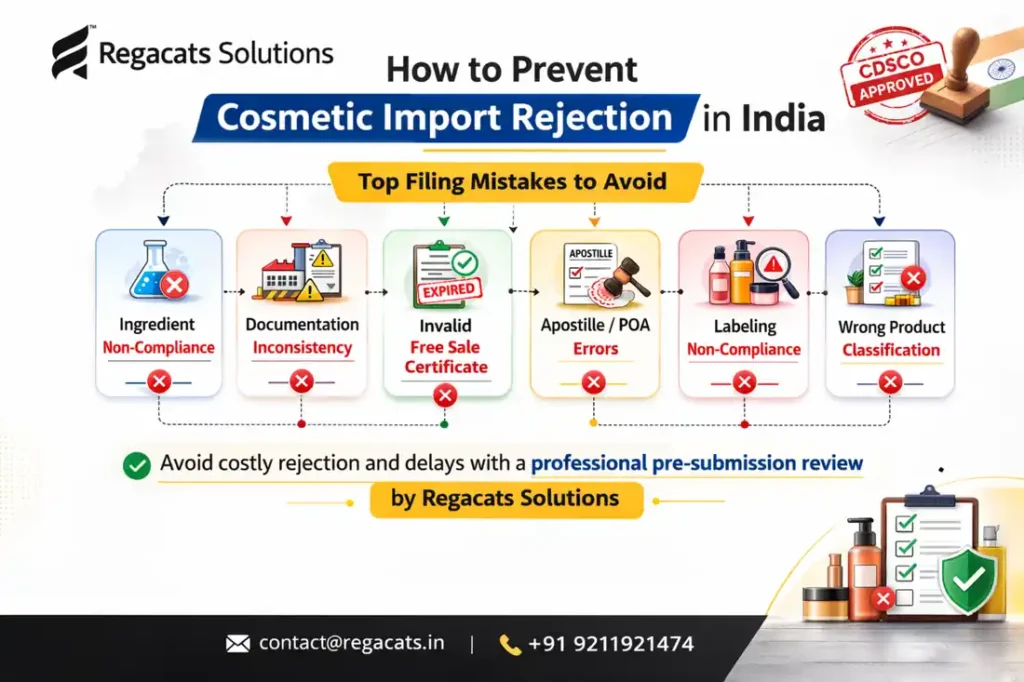
You can significantly reduce rejection risk by implementing structured preparation.
Conduct Pre-Submission Audit
Verify:
Ingredient compliance
Label accuracy
FSC validity
Apostille authenticity
Manufacturer documentation
Maintain Documentation Consistency
Ensure identical manufacturer and product details across all submitted files.
Avoid Therapeutic Claims
Keep claims cosmetic in nature to prevent reclassification.
Seek Professional Review
If you lack regulatory experience, working with a Cosmetic import registration consulting services in India improves approval predictability and reduces rejection risk.
Professional review identifies documentation gaps before submission and manages regulatory queries efficiently.
About Regacats Solutions
Regacats Solutions is an India-based regulatory consulting firm specializing in CDSCO cosmetic import licensing, medical device import registration, and FSSAI regulatory compliance. With extensive experience supporting Indian importers and global cosmetic brands, we assist with COS-1 and COS-2 registration, labeling compliance, Legal Metrology requirements, and post-approval regulatory obligations. Our team focuses on India-specific compliance frameworks to ensure faster approvals, accurate documentation, and long-term regulatory compliance.
Content Reviewed by
Regulatory Experts at Regacats Solutions
Specialists in CDSCO cosmetic import licensing, Legal Metrology compliance, EPR authorization, medical device import registration, and FSSAI regulatory consulting in India.
Conclusion
Understanding why CDSCO rejects cosmetic import applications in India gives you strategic advantage. Most rejections result from preventable documentation inconsistencies and compliance gaps rather than complex legal barriers.
Therefore, Preventing Cosmetic Import Rejection India should be a priority before filing Form COS-1. Align documents carefully, validate ingredient composition, ensure label compliance, and verify manufacturer credentials.
If you want structured compliance guidance and reduced rejection risk, Regacats Solutions provides regulatory support for cosmetic import registration under CDSCO.
Ready to launch in India?
Get COS-2 registration services and start import.
Talk to a Regulatory Expert Now
Contact:
 contact@regacats.in
  +91 9211921474 — Get a free consultation