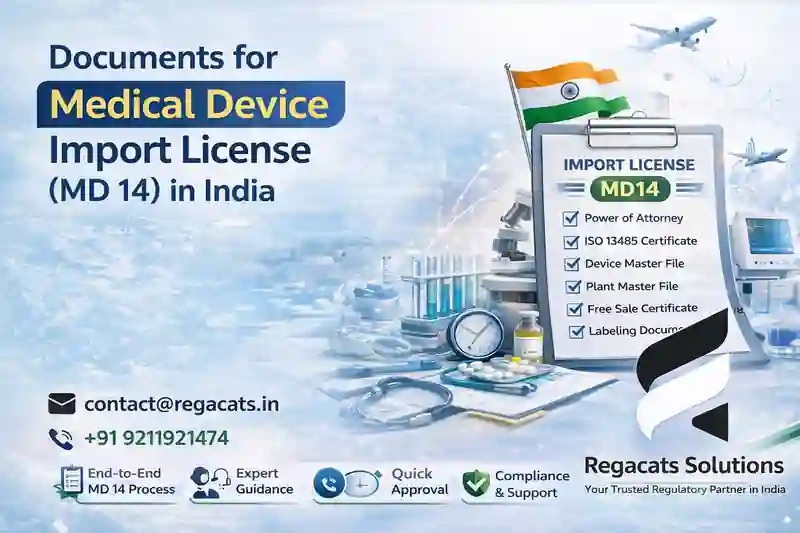

Documents for Medical Device Import License in India (MD14 & MD15 Complete Checklist Guide)
Understanding the documents for medical device import license in India is the most critical step before applying to CDSCO under the Medical Device Rules, 2017. Every foreign manufacturer and Indian importer must prepare complete and compliant documents for medical device import before submitting Form MD14. Therefore, documentation accuracy directly determines approval timelines, regulatory queries, and commercial launch readiness.
Before preparing the documents for medical device import license, applicants should clearly understand the overall regulatory pathway under CDSCO. You can review our detailed medical device import license guide to understand the complete MD14 and MD15 process, classification rules, and approval framework in India.
Although many applicants focus only on government fees and timelines, documentation quality ultimately controls the outcome. Consequently, importers who prepare structured regulatory files experience fewer objections and faster MD15 approvals.
In this comprehensive guide, you will learn:
Complete documents for medical device import under MD14 and MD15
Detailed explanation of Device Master File (DMF) and Plant Master File (PMF)
Labeling and certificate requirements
Common documentation errors that delay CDSCO approval
Practical strategies to avoid regulatory queries
This guide applies strictly to medical devices regulated by CDSCO and does not apply to drugs or cosmetic imports.
Complete Documents for Medical Device Import License Under MD14 Application
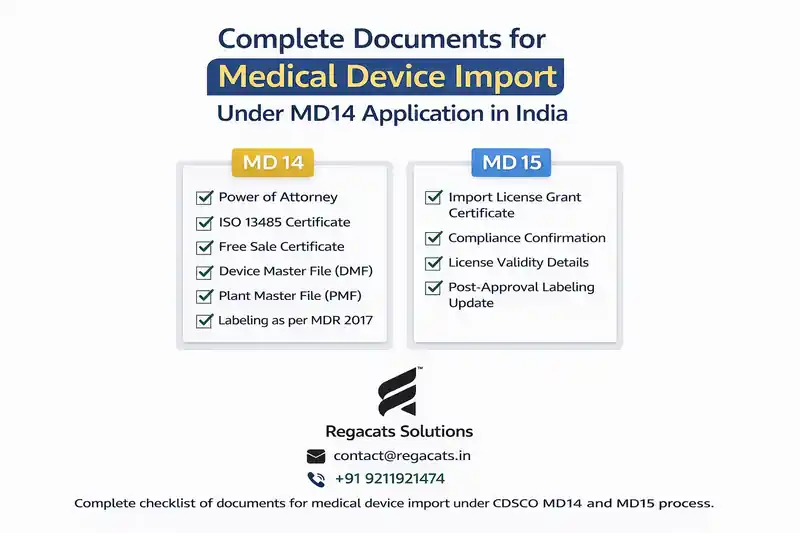
Before CDSCO grants an MD15 import license, the applicant must submit Form MD14 along with mandatory documents for medical device import. Each document must comply with prescribed formats and regulatory standards.
Below is the primary checklist:
Power of Attorney from Foreign Manufacturer
ISO 13485 Certificate
Free Sale Certificate
CE Design Certificate (for higher-class devices)
Device Master File (DMF)
Plant Master File (PMF)
Labeling as per MDR 2017
Wholesale License of Indian Authorized Agent
Applicants must ensure that every document aligns with classification, technical details, and intended use. Otherwise, CDSCO may raise clarification queries.
Moreover, CDSCO evaluates documentation consistency across all submitted files. Therefore, discrepancies between certificates, labeling, and technical data frequently result in avoidable delays.
Power of Attorney in Documents for Medical Device Import
Since foreign manufacturers cannot apply directly to CDSCO, they must appoint an Indian Authorized Agent for medical devices through a legally executed Power of Attorney. The authorized agent acts as the regulatory representative in India, manages communication with CDSCO, and ensures post-approval compliance. Therefore, selecting a reliable agent is a strategic regulatory decision.
The Power of Attorney must clearly state:
Manufacturer’s legal name and address
Scope of authorization
List of devices covered
Regulatory representation rights
Signature and notarization details
Furthermore, the document must follow proper legalization procedures depending on the country of origin. Incorrect notarization or missing clauses often trigger objections.
Therefore, applicants should draft this document with precise legal language to avoid compliance complications.
Device Master File (DMF)
The Device Master File represents the technical foundation of documents for medical device import. CDSCO relies heavily on the DMF to assess product safety, design, and regulatory compliance.
The DMF must include:
Device description and specifications
Intended use and indications
Risk classification justification
Design and manufacturing overview
Essential Principles compliance
Risk management summary
Clinical evidence (if applicable)
Shelf-life validation data
Since Class C and D devices undergo deeper scrutiny, technical depth becomes even more important. Consequently, incomplete risk analysis or vague intended use descriptions frequently lead to extended review cycles.
Additionally, the DMF must align with labeling information and Free Sale Certificate details. Regulatory officers often cross-check consistency across documents.
Plant Master File (PMF)
The Plant Master File describes the manufacturing facility and quality systems. Although many applicants underestimate its importance, CDSCO evaluates it carefully.
The PMF should cover:
Manufacturing site overview
Quality management system structure
Production processes
Environmental controls
Validation procedures
Packaging and storage systems
Furthermore, ISO 13485 certification must reflect the manufacturing activities described in the PMF. If inconsistencies appear, CDSCO may request clarification.
Therefore, manufacturers should align their PMF with actual operational practices to avoid technical queries.
Labeling Requirements
Labeling compliance forms a mandatory component of documents for medical device import. As per MDR 2017, labeling must include specific details.
Required labeling elements include:
Name and address of manufacturer
Name and address of Indian Authorized Agent
Device name and model
Batch or serial number
Manufacturing and expiry dates
Intended use
Storage conditions
Warnings and precautions
Additionally, after license approval, the import license number must appear on labels. Therefore, applicants must design labels with future compliance considerations in mind.
Improper labeling often results in objections. However, applicants who review labeling early reduce revision risks significantly.
Certificates Required in Documents for Medical Device Import License
Several certificates support technical compliance:
ISO 13485 Certificate
This certificate confirms quality management compliance. It must remain valid during submission.
Free Sale Certificate
The Free Sale Certificate confirms that the product is legally sold in the country of origin.
CE Design Certificate (If Applicable)
For higher-class devices, CE certification strengthens technical validation.
Expired certificates, mismatched product names, or incomplete scope descriptions frequently delay approvals. Therefore, applicants should verify certificate details before filing.
Common Mistakes in Documents for Medical Device Import License
Although the process appears structured, several mistakes commonly occur.
Frequent documentation errors include:
Incorrect risk classification
Missing annexures in Device Master File
Incomplete Power of Attorney legalization
Inconsistent manufacturer name across documents
Weak clinical evidence for higher-class devices
Labeling deviations from MDR 2017
Moreover, delayed response to CDSCO queries extends timelines significantly. Consequently, proactive documentation review plays a crucial role.
How to Prepare Documents for Medical Device Import License Without Regulatory Delays
While government requirements remain defined, applicants can take several steps to minimize approval risks.
First, conduct a detailed classification assessment.
Second, prepare a structured Device Master File aligned with global regulatory standards.
Third, validate certificates for scope and validity.
Additionally, ensure labeling meets MDR 2017 requirements before submission.
Finally, appoint an experienced Indian Authorized Agent who understands query management.
Proper preparation of documents for medical device import significantly reduces regulatory risk and approval delays. However, many foreign manufacturers struggle with classification review, Device Master File structuring, and labeling compliance. Therefore, working with an experienced medical device import license consultant in India can streamline documentation, ensure regulatory alignment, and reduce avoidable CDSCO queries during the MD14 and MD15 review process.
Step-by-Step Filing Overview for MD14 and MD15
To summarize the process:
Determine device classification
Appoint Indian Authorized Agent
Prepare complete documents for medical device import
Submit MD14 application through SUGAM portal
Respond to CDSCO queries
Receive MD15 import license
This structured approach improves clarity and strengthens compliance confidence.