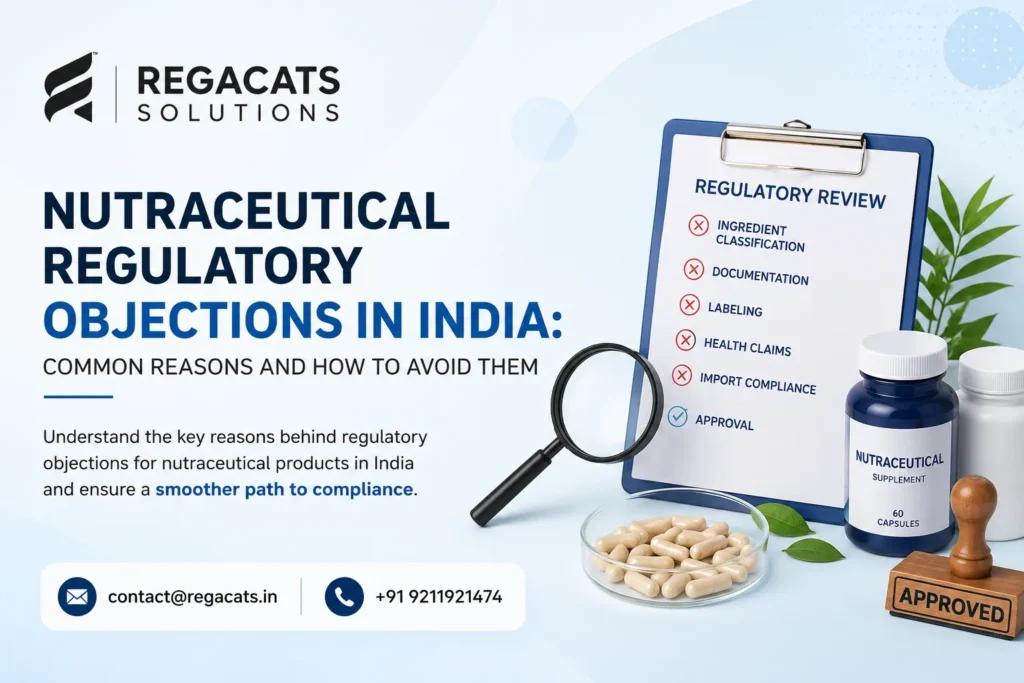

Businesses entering India’s nutraceutical sector often focus heavily on product development, branding, sourcing, and market expansion. However, regulatory compliance plays an equally important role in determining whether a product can successfully reach the market. Even well-developed brands can face delays due to nutraceutical regulatory objections arise during the review process.
Many companies mistakenly believe that a regulatory objection automatically means rejection. In reality, regulatory objections are often requests for clarification, additional supporting documents, technical justification, or compliance corrections. While these objections can delay commercialization, most can be prevented through proper planning and regulatory assessment.
As India’s nutraceutical market continues to grow, authorities are paying closer attention to ingredient compliance, product claims, labeling requirements, technical documentation, and import-related considerations. Consequently, businesses that understand common compliance challenges can significantly improve their chances of a smoother approval process.
This guide explains the most common reasons behind nutraceutical regulatory objections in India, how these issues arise, and what businesses can do to reduce compliance risks before product launch.
Need support from FSSAI License consultant for Nutraceutical products in India
What Are Nutraceutical Regulatory Objections?
Regulatory objections occur when authorities identify compliance concerns that require clarification, additional information, or corrective action before a product can move forward in the review process.
These objections may relate to:
- Ingredient classification
- Product formulation
- Technical documentation
- Product claims
- Labeling compliance
- Import-related issues
- Regulatory categorization
- Supporting scientific evidence
Importantly, regulatory objections do not always indicate a fundamental problem with the product itself. In many cases, they highlight gaps in documentation, inconsistencies in submissions, or unresolved compliance questions.
Nutraceutical products commonly face regulatory objections in India due to ingredient classification issues, incomplete documentation, unsupported claims, labeling errors, import compliance concerns, and incorrect regulatory categorization. Businesses can reduce objections through early compliance planning, proper documentation, and regulatory assessment before product launch.
Common Causes of Nutraceutical Regulatory Objections in India
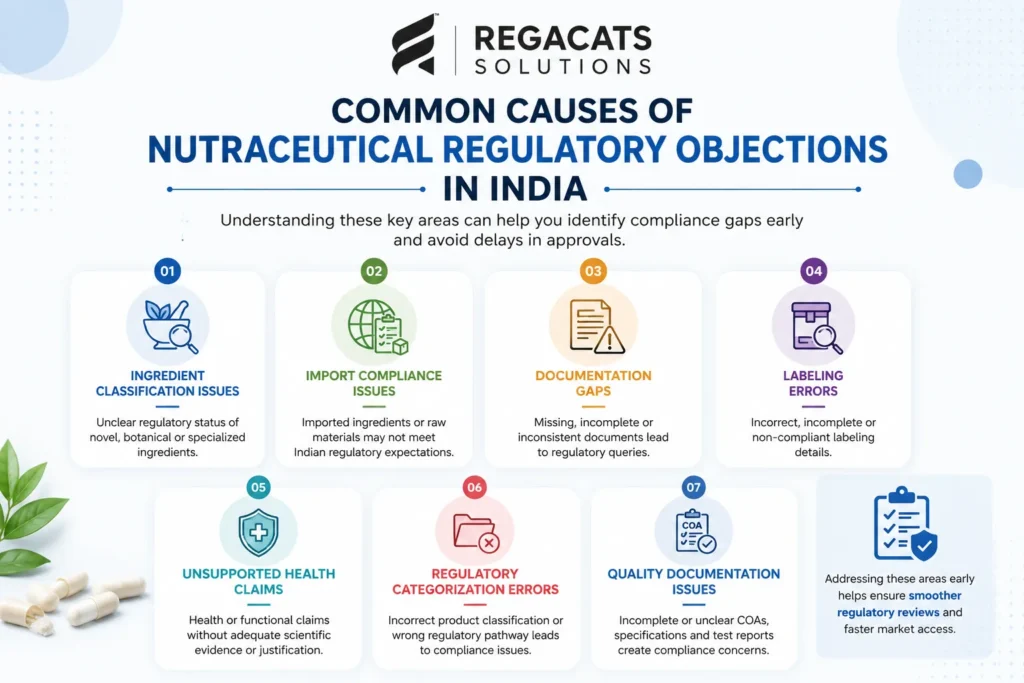
1. Ingredient Classification Issues
Ingredient classification remains one of the most common reasons nutraceutical products receive regulatory objections in India.
Many businesses assume that because an ingredient is natural, plant-based, or widely used internationally, it will automatically fit within existing regulatory frameworks. However, regulatory acceptance depends on how the ingredient aligns with applicable requirements and classifications.
Authorities often raise questions when products contain:
- Novel ingredients
- Specialized botanical extracts
- Emerging functional ingredients
- Innovative ingredient combinations
- Ingredients with limited regulatory history
When the regulatory status of an ingredient remains unclear, authorities may require additional information before proceeding further.
For this reason, businesses should evaluate Non-specified approval services for nutraceutical products in India during product development rather than after finalizing formulations.
Early ingredient assessment helps identify potential concerns before significant investments are made in manufacturing, packaging, or commercialization.
2. Imported Ingredients Without Proper Regulatory Assessment
India’s nutraceutical industry increasingly relies on imported ingredients and specialized raw materials sourced from international markets.
However, one of the most common compliance mistakes occurs when businesses assume that approval in another country automatically guarantees acceptance in India.
While international regulatory approvals may support safety discussions, they do not replace the need for India-specific compliance evaluation.
Authorities often raise objections when businesses fail to assess:
- Ingredient classification
- Intended product use
- Supporting technical documents
- Product claims
- Formulation details
- Regulatory applicability
Consequently, companies sourcing ingredients internationally should carefully assess nutraceutical import compliance services in India before finalizing procurement strategies.
This becomes particularly important for companies importing innovative ingredients, botanical extracts, probiotics, or specialized formulations.
Businesses that evaluate import-related compliance requirements early typically experience fewer delays and fewer regulatory queries.
3. Incomplete Documentation Packages
Documentation deficiencies consistently rank among the leading causes of regulatory objections.
Even when ingredients and formulations appear compliant, incomplete records can significantly delay the review process.
Common documentation issues include:
- Missing specifications
- Incomplete technical records
- Inconsistent product information
- Missing quality documents
- Inadequate scientific references
- Insufficient supporting evidence
Unfortunately, many businesses underestimate the importance of documentation until objections arise.
As a result, authorities frequently request additional records before continuing their evaluation.
Companies preparing submissions should ensure that all documents required for nutraceutical licensing are complete, organized, and internally consistent before filing.
A strong documentation package often reduces review timelines and improves overall submission quality.
4. Inconsistencies Between Submitted Documents
Another common issue involves inconsistencies across different regulatory documents.
Authorities carefully compare information provided in:
- Product specifications
- Technical dossiers
- Labels
- Ingredient declarations
- Quality records
- Supporting documentation
Even minor inconsistencies can generate regulatory questions.
Examples include:
- Different ingredient names appearing in separate documents
- Conflicting formulation details
- Variations in dosage information
- Inconsistent product descriptions
- Mismatched technical specifications
Although these issues may appear insignificant, they often create concerns regarding document reliability and product accuracy.
Therefore, businesses should conduct a comprehensive document review before submission.
Consistency across all regulatory materials demonstrates professionalism and helps reduce avoidable objections.
5. Unsupported Health and Functional Claims
Health-related claims attract significant regulatory attention because they directly influence consumer expectations.
Businesses often create compliance risks when marketing claims exceed available supporting evidence.
Regulatory objections frequently arise when:
- Claims appear exaggerated
- Scientific support remains insufficient
- Product benefits are overstated
- Marketing language implies treatment outcomes
- Supporting documentation does not align with label claims
While strong marketing messages may appear attractive from a commercial perspective, compliance considerations should always guide claim development.
Therefore, companies should assess health claim approval services in India before finalizing labels, packaging, and promotional materials.
Early claim review reduces the likelihood of objections while protecting long-term brand credibility.
6. Labeling Compliance Issues
Labeling remains one of the most scrutinized aspects of nutraceutical compliance.
Even when ingredients, formulations, and documentation satisfy regulatory expectations, labeling mistakes can still trigger objections.
Common labeling issues include:
- Missing declarations
- Incorrect product descriptions
- Inconsistent ingredient information
- Improper presentation of claims
- Formatting deficiencies
- Incomplete mandatory information
Since labels serve as the primary communication tool between businesses and consumers, authorities review them carefully during compliance evaluations.
Furthermore, label corrections often require redesign efforts that increase costs and delay product launches.
Businesses should perform detailed compliance reviews before finalizing packaging artwork.
A proactive label review process often prevents costly revisions later.
7. Incorrect Regulatory Categorization
Selecting the appropriate regulatory pathway is critical for nutraceutical compliance.
However, many businesses misunderstand how their products fit within regulatory frameworks.
Common categorization issues include:
- Incorrect product classification
- Improper application pathways
- Misinterpretation of ingredient status
- Failure to evaluate formulation characteristics
- Inaccurate regulatory assumptions
These mistakes can result in:
- Additional queries
- Delayed reviews
- Refiling requirements
- Increased compliance costs
Therefore, businesses should fully understand nutraceutical licensing guide before initiating regulatory submissions.
Accurate categorization often improves efficiency and reduces unnecessary complications.
8. Quality Documentation and COA Deficiencies
Quality documentation plays an important role in supporting product compliance.
Authorities often review analytical records to verify product consistency and quality standards.
Common concerns include:
- Incomplete Certificates of Analysis
- Missing analytical details
- Unclear testing methodologies
- Insufficient quality specifications
- Inconsistent laboratory records
When quality documentation fails to support product specifications adequately, authorities may request clarification or additional evidence.
Businesses should ensure that analytical records remain current, complete, and consistent with all supporting materials.
Strong quality documentation enhances confidence in the overall submission package.
9. Lack of Regulatory Assessment During Product Development
Many compliance challenges originate long before the submission stage.
Businesses frequently focus on:
- Product innovation
- Ingredient sourcing
- Brand development
- Marketing strategies
while delaying regulatory assessment until late in the process.
Unfortunately, this approach often creates avoidable compliance issues.
For example, companies may discover regulatory concerns only after:
- Formulations have been finalized
- Packaging has been printed
- Marketing campaigns have been prepared
- Inventory investments have been made
Therefore, businesses should integrate regulatory evaluation into product development from the beginning.
Early compliance planning reduces uncertainty and improves decision-making.
10. Absence of a Comprehensive Compliance Strategy
Many regulatory objections occur because businesses treat compliance as a documentation exercise rather than a strategic function.
Successful nutraceutical companies generally:
- Assess ingredients early
- Evaluate import requirements
- Review product claims
- Verify documentation quality
- Confirm regulatory categorization
- Conduct label reviews
- Maintain document consistency
By contrast, reactive compliance approaches often create repeated objections and extended timelines.
Businesses that adopt a structured compliance strategy generally achieve better outcomes and greater market readiness.
How to Reduce Nutraceutical Regulatory Objections in India
Businesses can significantly reduce compliance risks by following a proactive approach.
Practical Compliance Checklist
- Evaluate ingredient compliance before formulation finalization
- Assess imported ingredients before procurement
- Organize technical documentation early
- Verify document consistency
- Review quality records thoroughly
- Validate health and functional claims
- Conduct detailed label reviews
- Confirm regulatory categorization
- Address compliance risks during product development
- Seek professional guidance when uncertainties arise
Although no process can eliminate every regulatory question, proactive planning often reduces delays and improves submission quality.
Why Early Compliance Planning Creates Competitive Advantage
Businesses often view compliance as an administrative requirement. However, effective regulatory planning can become a competitive advantage.
Companies that address compliance early frequently benefit from:
- Faster market access
- Reduced correction costs
- Improved product launch timelines
- Greater regulatory confidence
- Better resource allocation
- Stronger investor confidence
Moreover, proactive compliance helps businesses avoid disruptions that can affect manufacturing schedules, inventory planning, and commercial objectives.
As competition within the nutraceutical industry increases, regulatory preparedness becomes increasingly important.
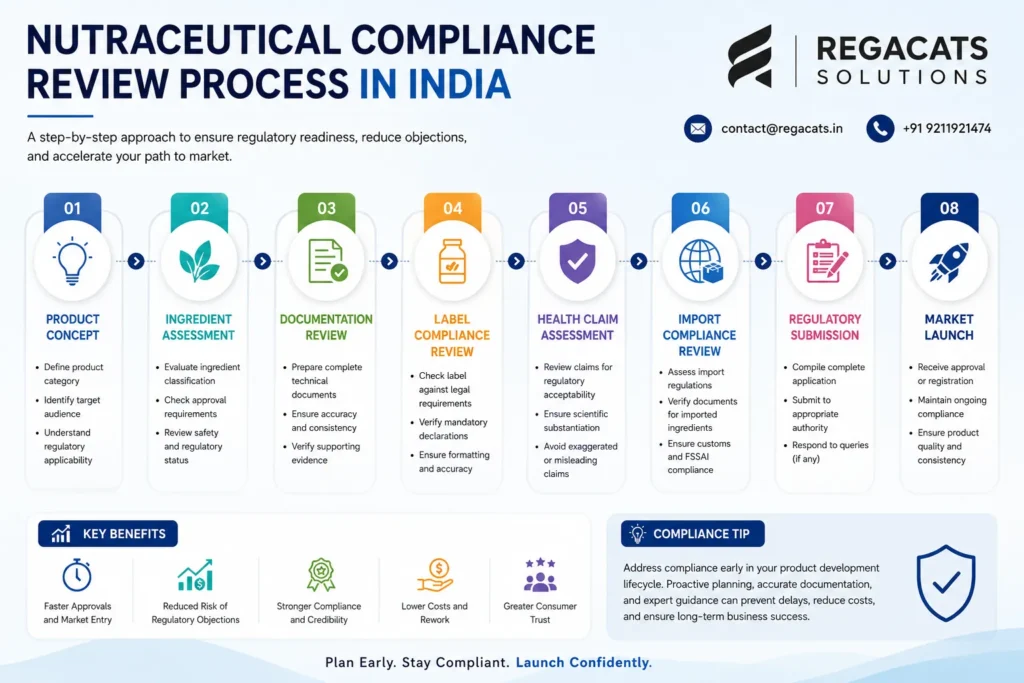
How Regacats Solutions Supports Nutraceutical Companies
Navigating nutraceutical compliance requires more than completing forms and submitting documents. Businesses must evaluate ingredients, claims, technical records, import requirements, and regulatory classifications before launch.
At Regacats Solutions, we assist manufacturers, importers, startups, brand owners, and international businesses with:
- Nutraceutical licensing and registration services in India
- Ingredient approval requirements for nutraceutical products
- Nutraceutical import compliance in India
- Nutraceutical health claim compliance
- Food import compliance support in India
- Indian Authorized Agent services for nutraceutical companies
- Regulatory documentation review and compliance strategy
By identifying compliance risks early, businesses can reduce objections, improve submission quality, and accelerate market readiness.